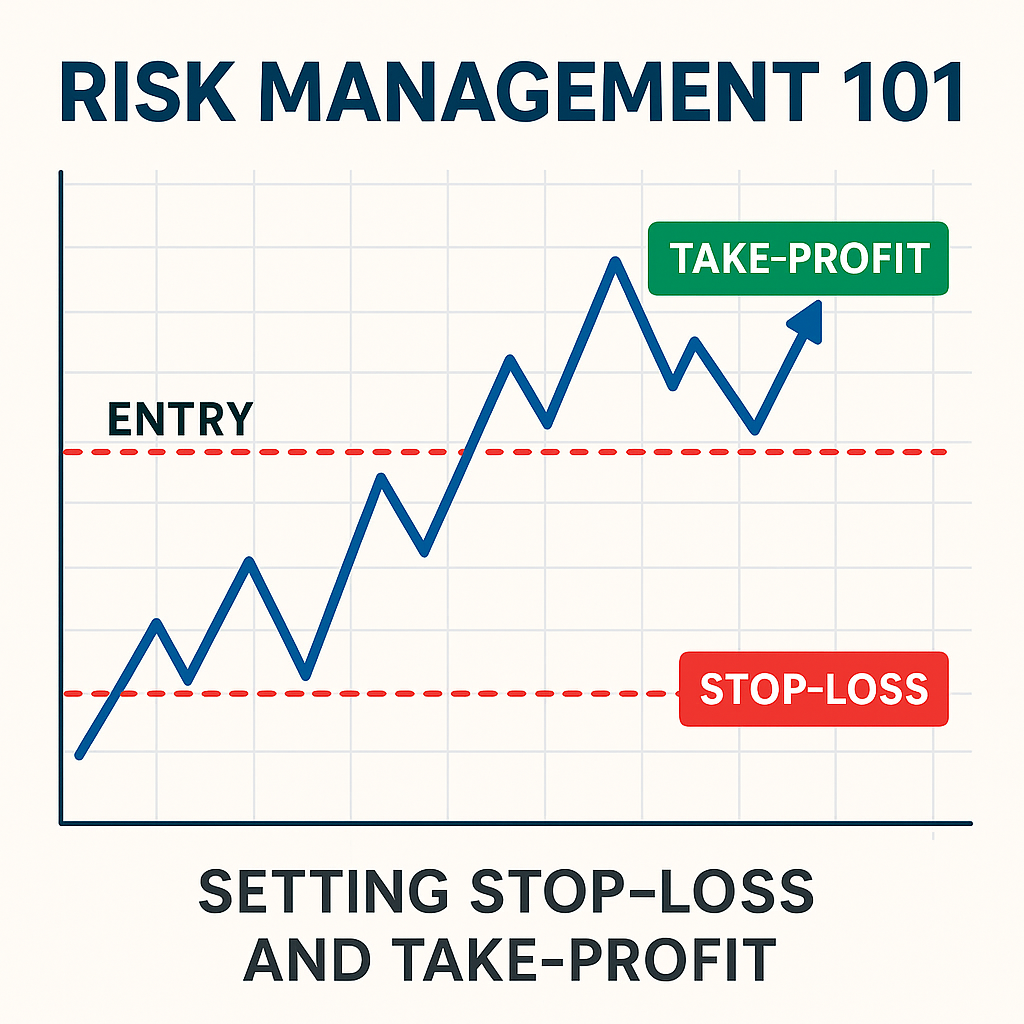
Managing risk is what separates traders who survive from those who burn out. If you’re serious about trading forex or crypto, understanding how to set your stop-loss and take-profit levels is non-negotiable. This guide will walk you through the basics—and the nuances—of protecting your capital and maximizing your wins.
Why Risk Management Matters in Trading
Even the best trade setups can fail. That’s why you need predefined exit rules.
Risk management helps you:
- Protect your account from major losses
- Eliminate emotional decision-making
- Build consistency over time
🛡️ Think of your stop-loss as insurance and your take-profit as your payout.
Trading without risk management is like driving without brakes. You might go fast for a while, but eventually, the crash is inevitable.
What Is a Stop-Loss?
A stop-loss is a preset order that closes your trade if the market moves against you. It’s the price at which you say, “I’m wrong, and I’m out.”
Types of stop-losses:
- Fixed pip/dollar amount: A set distance from your entry
- ATR-based: Adjusts to market volatility
- Chart-based: Placed beyond support/resistance or patterns
📉 Example: You buy EUR/USD at 1.1000 and place your stop at 1.0950. If price drops to 1.0950, you’re out with a controlled loss.
Setting stop-losses gives your trades room to breathe while shielding your account from large losses.
What Is a Take-Profit?
A take-profit order locks in profits when the price hits a certain target.
Why it’s important:
- Prevents greed from taking over
- Lets you plan reward-to-risk ratios
- Removes guesswork and hesitation
📈 Example: If you expect a 100 pip move and you risk 50 pips, your take-profit goes at +100 pips.
Take-profit orders help you capitalize on your analysis without emotional interference.
The Golden Rule: Risk-to-Reward Ratio
This ratio compares how much you risk vs how much you aim to gain.
Common ratios:
- 1:2 (risk $50 to make $100)
- 1:3 (risk $100 to make $300)
💡 Tip: Never enter a trade with less than a 1:2 risk-to-reward ratio.
A good ratio doesn’t just protect your capital—it makes your strategy mathematically viable even with a modest win rate.
How to Place a Smart Stop-Loss
- Use structure: Place it beyond recent highs/lows, key levels, or chart patterns.
- Factor in volatility: Use the ATR or historical volatility range to avoid getting stopped prematurely.
- Position size accordingly: Base your lot size on how far your stop is—not the other way around.
🧠 Discipline reminder: Don’t widen your stop to avoid being stopped out. That’s fear, not strategy.
Example: If your stop is 50 pips away and you want to risk $50, trade 0.1 lots. Know the math behind every trade.
How to Place an Effective Take-Profit
- Set realistic targets: Use prior highs/lows, Fibonacci extensions, average daily range.
- Use partial exits: Lock in profits at target one, and let the rest ride with a trailing stop.
- Let winners run: In trending markets, trailing stops allow you to ride extended moves.
⚖️ Balance tip: Your take-profit should match the strategy’s intent. Scalping? Smaller TP. Swing trading? Larger TP.
Risk Management in Different Market Conditions
- Trending markets: Use wider stops and trailing take-profits to stay in trades longer.
- Ranging markets: Place tight stops outside the range; aim for the opposite range edge.
- News events or high volatility: Reduce your position size or avoid trading. Spreads widen and slippage increases risk.
🌀 Adaptation is key: The market is dynamic. So your stop and TP logic should be flexible too.
Examples of SL/TP in Action
Trade Setup Example 1: Range Breakout
- Entry: BTC/USD breaks resistance at $30,000
- Stop-Loss: Below the breakout zone at $29,700
- Take-Profit: Measured move to $31,500
Trade Setup Example 2: Trend Pullback
- Entry: Buy EUR/USD on bullish engulfing candle at 1.0800
- Stop-Loss: Below swing low at 1.0760
- Take-Profit: Previous high at 1.0880
Seeing these setups in action helps connect theory to real trades.
Tools to Help You Set Risk Parameters
- Position Size Calculators: Automatically determine how much to trade based on your account size and stop distance
- ATR (Average True Range): Gauge average volatility for setting dynamic stops
- Trading Platforms: MT4/5, TradingView let you set SL/TP visually and simulate trades
- AITradingSignals.co: Offers trade ideas with built-in risk/reward metrics and smart stop levels
🔧 Pro workflow: Define your SL/TP before you enter any trade. Stick to it unless your plan justifies a change.
Final Thoughts: Trade to Survive, Then Thrive
Winning traders think in probabilities, not guarantees. Properly set stop-loss and take-profit levels protect your downside and define your upside. They take the emotion out of the moment and let the math do the work.
So before your next trade, ask yourself: “What’s the risk? What’s the reward?”
Let that answer guide your entry. Risk management isn’t optional—it’s essential.
🧭 Want to trade smarter? Test your stop-loss placement and risk control using a demo account before going live.