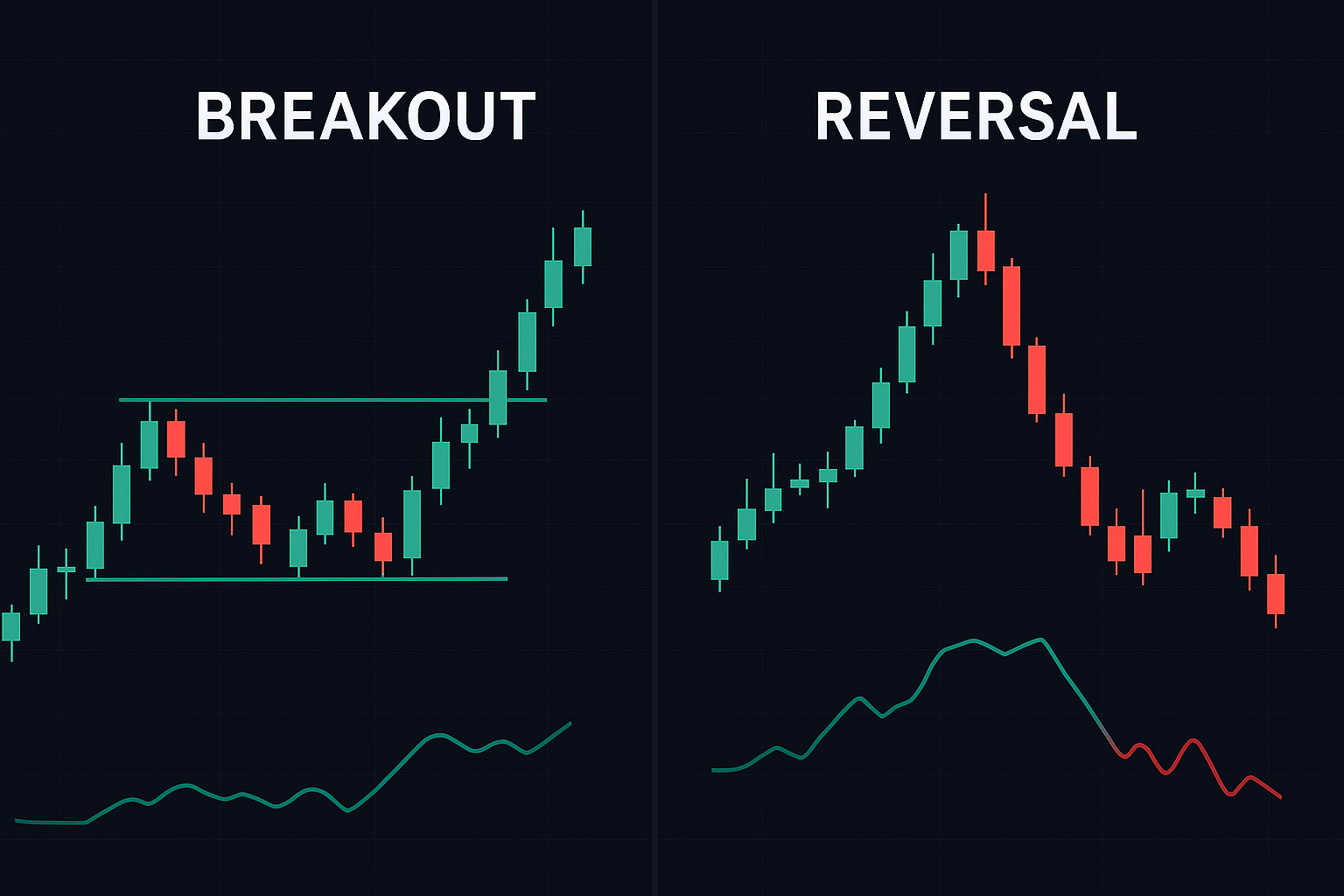
Calling a reversal when the market is actually setting up for a breakout (or vice versa) is a fast path to frustration. Reversals start new trends; breakouts usually continue the current directional bias after compression. The tools to tell them apart are different. This guide gives you practical, testable rules to classify price action in real time, plus copy‑ready playbooks and risk controls you can automate with algorithmic trading/AI trading tools.
Related on Indicators101:
- Price Action Trading Basics (Support/Resistance Breakouts)
- How to Trade Breakouts in Forex (Techniques + Indicators)
- Identifying False Breakouts: Tips to Avoid Traps
- Risk Management 101: Position Sizing for Forex & Crypto
- How to Build & Backtest a Strategy in TradingView
Promise: In 15 minutes you’ll have a checklist to label a move as likely reversal or breakout, along with two complete systems—one for each—so you always have a plan.
Core Definitions (Keep These Straight)
- Breakout: A confirmed close beyond a well‑defined boundary (range high/low, inside bar, triangle) that follows volatility compression. Tends to continue the existing directional bias on the next higher timeframe.
- Reversal: A structure shift—the first higher high + higher low after a downtrend (or lower low + lower high after an uptrend). Often begins after exhaustion signals (divergence, failed break, capitulation volume) and context changes (funding, breadth, macro).
Think in timeframe pairs: trades on M15 confirm with H1; trades on H1 confirm with H4/D1.
Snapshot: How They Usually Look
Breakout DNA
- Prior price action: Sideways base or tight range; ATR below its 20‑bar average.
- Trigger: Close beyond structure in the direction of the prevailing bias.
- Confirmation: RVOL surge (or tick‑volume spike), MACD line above/below zero, RSI > 50 for longs (<50>
- Follow‑through: Clean trend bars; retest holds with lighter volume.
Reversal DNA
- Prior price action: Exhaustion after a trend: parabolic run, momentum divergence (RSI/MACD), crowded funding and high OI in crypto; failed break through key level.
- Trigger: Failed‑break reclaim (wick beyond level → close back inside) or first structure shift (HH/HL after downtrend, LL/LH after uptrend).
- Confirmation: RSI crosses the 50 line in the new direction, MACD flips through zero, OBV/CMF stop declining and turn up.
- Follow‑through: Break and hold of prior swing, not just intrabar pokes.
The Decision Checklist (Live Market)
Run this quick stack before acting. If most answers fall on one side, trade that playbook.
- Volatility Regime: Is ATR(14) below its 20‑bar SMA (compression) → favors breakout. Is ATR already high with wide candles → favors reversal (exhaustion).
- Structure on the Next Higher TF: Is the higher timeframe trending and we’re basing with the trend → breakout. Are we tagging a multi‑week level after a long run → reversal favored.
- Momentum: Is MACD already on the trend side (above 0 for longs) and RSI > 50 → breakout. Do you see bearish/bullish divergence → reversal.
- Volume/Flow: RVOL rising into the break and OBV making new highs/lows → breakout. Capitulation spike, then drying volume and VWAP reclaim → reversal.
- Sentiment (crypto): Neutral/normal funding & OI → safer breakout. Extreme, persistent funding with rising OI → crowded; watch reversal.
If signals are mixed, stand aside or require a retest entry.
Playbook 1 — Breakout After Compression (H1)
When to use: Higher‑timeframe trend is intact; you see a clear base on your entry timeframe.
Rules (long example):
- Compression: ATR(14) < SMA(ATR,20); 10–40 bar base or prior day high/low capping range.
- Trigger: Candle closes above the base/level.
- Confirms: RVOL ≥ 1.8 (or tick RVOL for forex) and MACD line > 0 (or RSI(14) > 50) on/near breakout bar.
- Entry: On close or 25–40% pullback into breakout candle (limit).
- Stop: Opposite side of base − 0.5× ATR (or 1.5× ATR if wider).
- Targets: TP1 = 1× base height (take 40–50% & move to BE); TP2 = 2× base or 1.5× ATR trail.
- Guards: Skip 10–15 minutes before high‑impact news; prefer London/NY sessions for forex. For crypto, reduce size if funding is very positive.
Why it works: You demand structure + compression + confirmation before committing.
Playbook 2 — Failed‑Break Reversal (M30–H1)
When to use: Extended trend into a major level; you spot exhaustion and a quick reclaim.
Rules (short example after false upside break):
- Setup: After an uptrend, price wicks above resistance, then closes back inside the range/structure within 1–3 bars.
- Reclaim: Price closes below VWAP (or level) soon after, showing acceptance back inside.
- Momentum: RSI(14) < 50> and/or MACD line < 0> on the reclaim bar.
- Entry: On the reclaim close; conservative traders wait for a lower high (first LH).
- Stop: Above the failure wick + 0.5× ATR buffer.
- Targets: Range midpoint first; then opposite side; or +1.5R / +3R with ATR trail.
- Guards (crypto): Prefer when funding is elevated and OI just expanded; risk of squeeze exists—size small and avoid thin hours.
Why it works: Trapped breakout chasers must exit, fueling the reversal.
Telltale Mistakes (and Fixes)
- Entering on wicks: Fix → Demand close confirmation. Wicks are where traps live.
- Confusing pullbacks for reversals: Fix → Require a structure shift (HH/HL or LL/LH) or a VWAP/AVWAP reclaim before calling reversal.
- Trading breakouts without compression: Fix → Add ATR percentile filter; no compression, no trade.
- Ignoring session/news: Fix → Put no‑trade windows (5–15 minutes around releases) in your plan or bot.
- Over‑stacking indicators: Fix → Use a lean stack: Structure + ATR + (RSI or MACD) + RVOL/VWAP.
Examples You Can Copy
Example A — EURUSD H1 Breakout
- Equity $10,000; risk 1% ⇒ $100.
- Base height 22 pips; ATR < ATR> 0; RVOL 2.0.
- Stop: base low − buffer = 26 pips → size ≈ $100 ÷ 26 ≈ $3.85/pip (~0.39 mini lots).
- TP1: +22 pips; TP2: +44 pips or ATR trail.
Example B — BTCUSDT M30 Failed‑Break Reversal
- Equity $6,000; risk 0.5% ⇒ $30.
- Uptrend into prior ATH zone; wick above then close back in; VWAP reclaim down; RSI < 50>
- Stop 1.0% above entry; perps 3× → Notional = $30 × 3 ÷ 0.01 = $9,000.
- Targets: Mid‑range then opposite edge or +1.5R/+3R; use ATR trail.
Minimal Indicator Stack for This Topic
- ATR(14) + SMA(ATR,20) → compression filter & trail engine.
- RSI(14) or MACD(12/26/9) → momentum bias/confirm.
- RVOL/Volume (or tick volume for forex) → breakout commitment.
- VWAP/AVWAP → reversal reclaims and failure detection.
Add others only if they improve out‑of‑sample results.
Backtesting the Decision Rules (No Hindsight)
- Write rules exactly (closes, retests, ATR thresholds, momentum, RVOL/VWAP conditions).
- Model costs and slippage; include funding for perps. Breakouts slip—size smaller.
- Test across regimes (trend/range; high/low vol) and assets (EURUSD, GBPUSD, BTC, ETH).
- Use out‑of‑sample windows or walk‑forward if you tweak multipliers.
- Forward test 2–6 weeks on paper/tiny size; compare expectancy (R/trade), profit factor, max drawdown.
Goal: Your breakout system should outperform during compression; your reversal system should outperform after runs or at major levels. Combined, they cover more conditions.
Psychology & Process
- Stay flexible: Label the environment first, then select the matching playbook. Don’t force a breakout in exhaustion or a reversal in fresh bases.
- Kill switch: After 3 consecutive losses in one playbook, pause that playbook for the session and re‑assess context.
- Journal: Screenshot each trade with labels (compression, breakout, reversal, failure). Pattern recognition compounds.
- Automation: Let bots enforce ATR filters, no‑trade windows, position sizing, and partial exits. Keep human oversight for news/context.
FAQs
How do I know if a breakout is really a reversal on a higher timeframe?
Check the next higher timeframe structure. If the break flips the higher‑TF swing sequence (e.g., breaks a weekly lower high), it can be the first leg of a reversal at that scale.
Is divergence enough to call a reversal?
No. Treat divergence as a warning. Wait for reclaim/structure shift or a failed‑break pattern.
Which timeframe is best for learning?
Start on H1. It’s clean enough to see structure and fast enough to collect 30–50 trade samples per setup.
Can I mix both playbooks in one day?
Yes, if context changes. Keep risk budgets separate and cap total open risk ≤ 3%.
Summary & Next Steps
Breakouts thrive on compression and confirmation. Reversals start with exhaustion and structural change. Use the checklist to label the environment, then execute the matching playbook with disciplined risk and partial exits. Backtest both systems, forward test small, and let algorithmic trading tools enforce the boring parts.
Call to Action: Want plug‑and‑play tools for these playbooks? Give our Indicators a try at AITradingSignals.co for breakout detection, ATR‑based risk, and VWAP/AVWAP reclaim signals.
Prefer a guided path?
Check out our courses at aitradingsignals.gumroad.com for step‑by‑step playbooks and TradingView labs.
Compliance & Disclaimer: This educational material is not investment advice. Trading involves risk, including possible loss of principal. Past performance does not guarantee future results. Use only original or licensed images/charts.