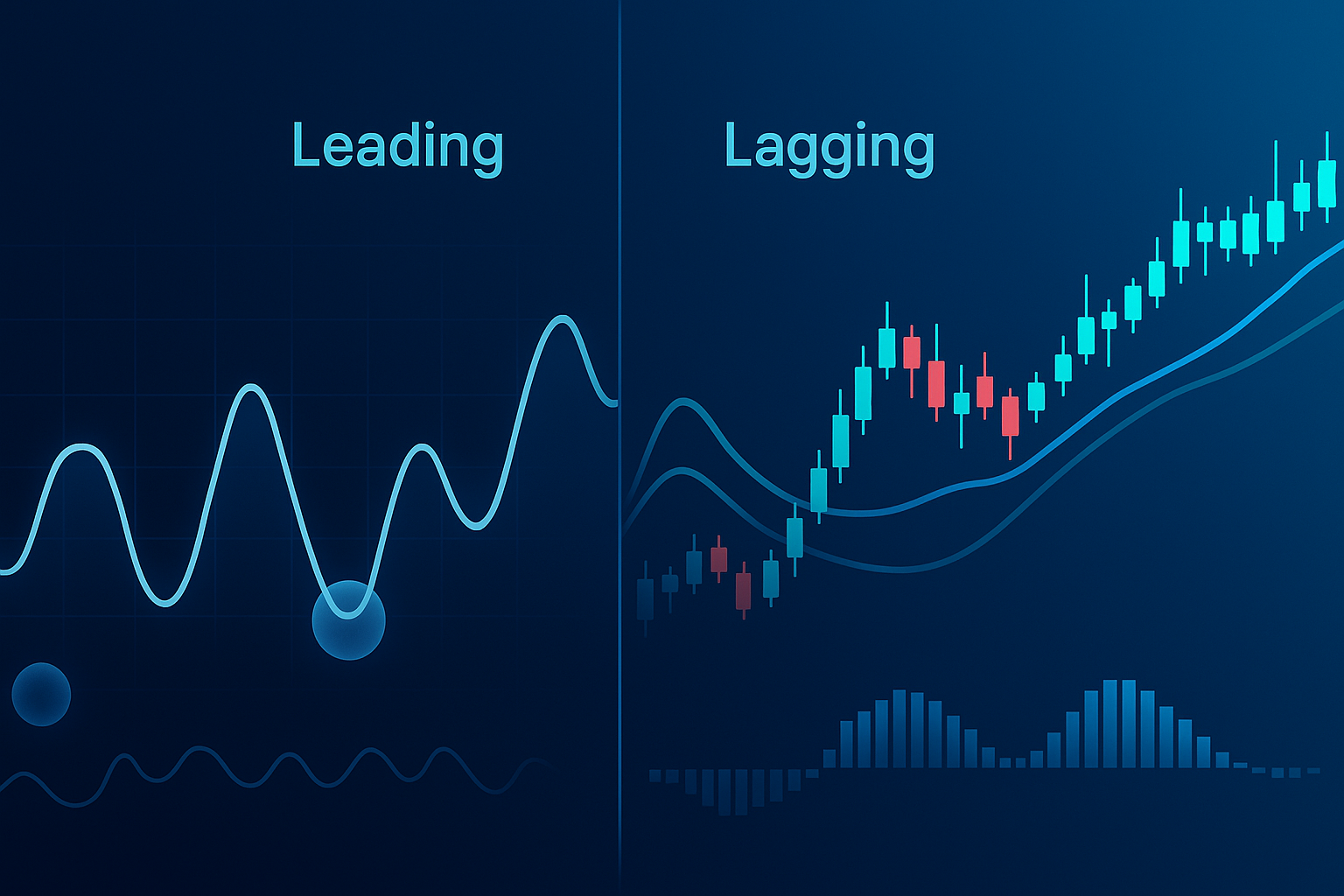
If you keep mixing leading and lagging indicators, you’ll either enter too early and get chopped—or enter too late and miss the meat of the move. The fix isn’t to pick a side; it’s to pair them on purpose. This guide explains what each type does, where they shine, where they fail, and how to combine them into testable trading playbooks you can automate with algorithmic trading/AI trading tools.
Related on Indicators101:
- Price Action Trading Basics (Support/Resistance Breakouts)
- Using Volume Indicators to Confirm Breakouts
- How to Use Momentum Indicators in Forex Trading
- Indicators101: Beginner’s Guide to Algorithmic Trading
Promise: In 15 minutes you’ll understand leading vs lagging, have copy‑ready rules for two strategies, plus risk and backtesting guardrails.
Quick Definitions (No Jargon)
- Leading indicators try to signal a potential move before price confirms. Examples: RSI divergences, Stochastic turns, ROC thresholds, sentiment extremes (funding/put‑call), Bollinger Band squeezes (volatility leads direction). They’re early but error‑prone without structure.
- Lagging indicators confirm and follow trends. Examples: Moving Averages (50/200 EMA/SMA), MACD zero‑line, Supertrend, Donchian channels, ATR trails. They’re late but reliable once a trend is underway.
Rule of thumb: Lead to anticipate, lag to confirm/manage. Use leading to find timing, lagging to define bias and exits.
Where Each Type Shines (and Fails)
Leading — Best for:
- Reversals at major levels (divergence + reclaim)
- Breakout timing after compression (BB squeeze + momentum pop)
- Scaling in on pullbacks (RSI 40–50 re‑cross)
Leading — Weak when:
- Markets are choppy; lots of false positives
- Major news hits; signals flip intra‑bar
Lagging — Best for:
- Trend identification and staying in winners (MA slopes, MACD above/below zero)
- Risk management with ATR trails
- Regime filters (price vs 200‑day; 50/200 cross)
Lagging — Weak when:
- Turning points; you’ll be late and might give back profit on reversals
Build a Balanced Indicator Stack (1–2 per job)
- Bias/Regime (lagging): 50/200 EMA (or SMA on higher TFs)
- Momentum/Trigger (leading): RSI(14) re‑cross or Stochastic(14,3,3) cross; ROC(10) threshold for breakouts
- Confirmation (lagging): MACD(12/26/9) zero‑line in trade direction
- Volatility & Risk (lagging): ATR(14) for stop buffers and trailing
- Context (optional leading): BB(20,2) squeeze for breakout setups; funding/IV extremes (crypto)
Keep it lean. Add an indicator only if it improves out‑of‑sample performance.
Playbook 1 — Trend Pullback (Lagging Bias + Leading Trigger)
When to use: Market trending on your higher timeframe; you want a clean timing signal to re‑enter.
Rules (long example, H1/H4):
- Bias (lagging): 50 EMA > 200 EMA and price > 200 EMA.
- Pullback: Price returns to 20 EMA or prior swing; RSI(14) dips to 40–50.
- Trigger (leading): Enter when RSI closes back above 50 and price closes above the 20 EMA.
- Stop (lagging): Below swing low − 1× ATR(14) buffer.
- Targets: Take 40–50% at +1.5R; trail remainder with 1.5× ATR (lagging) or a 50 EMA close.
- Guards: Skip 10–15 minutes before high‑impact news; reduce size if ATR percentile is extreme.
Why it works: Lagging sets the trend context; leading gives entry timing.
Playbook 2 — Squeeze Breakout (Leading Setup + Lagging Confirm)
When to use: You spot volatility compression; you want to catch the expansion but avoid head‑fakes.
Rules (long example, M15–H1):
- Setup (leading): Bollinger Band(20,2) squeeze — BandWidth in bottom 30% of past 6 months.
- Trigger (leading): Close outside upper band with ROC(10) > +0.3% or RSI > 50.
- Confirm (lagging): MACD line > 0 on/near breakout bar.
- Stop (lagging): Below breakout candle low − 0.5× ATR.
- Targets: 1×–2× the base height; partial at +1.5R; trail by 1.5× ATR.
- Guards (crypto): Avoid extremes in funding/OI; if funding > +0.05%/8h, halve size or require a retest entry.
Why it works: Leading finds the moment, lagging filters weak breaks and manages the run.
Choosing for Forex vs Crypto
- Forex: Use tick volume as a relative confirm; prefer London/NY sessions. Leading tools (RSI/Stoch) are cleaner with a trend filter.
- Crypto: Add funding & OI as leading sentiment inputs; keep risk smaller on alts. Lagging trend filters (50/200) still work well on H1/H4/D1.
Risk Management (Non‑Negotiable)
- Per‑trade risk: 0.5%–1.0% on majors/BTC/ETH; 0.25%–0.75% on volatile alts.
- Stops: Place beyond invalidating structure plus ATR buffer (0.5–1.5×).
- Partials: Take 40–50% at +1.5R, move to breakeven, trail by 1.5× ATR.
- Daily/weekly caps: Halt at −3R/day or −6R/week; avoid revenge trades.
Backtesting Your Combo (So You Don’t Fool Yourself)
- Write the rules first (bias, trigger, confirm, stops, exits).
- Model costs (spread/fees/slippage; funding for perps).
- Test across regimes (trend/range, high/low ATR) and assets (EURUSD/GBPUSD/BTC/ETH).
- Use out‑of‑sample windows or walk‑forward if you tune parameters.
- Forward test 2–6 weeks on paper/tiny size; compare expectancy (R/trade), profit factor, and max drawdown.
Sanity check: If a leading trigger improves entries but reduces overall expectancy vs the lagging‑only baseline, drop it.
Common Mistakes (And Fixes)
- All‑leading, no confirmation: Add a lagging bias (50/200 or MACD zero‑line) and ATR stops.
- All‑lagging, late to every party: Add a leading trigger (RSI re‑cross or squeeze break) to improve timing.
- Stacking too many indicators: Cap to one per job; more lines ≠ more edge.
- Ignoring session/news context: Add time filters and no‑trade windows to your plan or bot.
- Not journaling: Save screenshots of wins/losses with indicator states; your future tests will improve faster.
FAQs
Which is “better,” leading or lagging?
Neither alone. Use leading to enter, lagging to confirm/manage.
What settings should I start with?
RSI(14), BB(20,2), MACD(12/26/9), ATR(14), EMAs (20/50/200). Adjust only in tight logical ranges after testing.
Can I automate these playbooks?
Yes. Pine/MQL/Python can encode the rules, ATR stops, partials, and circuit breakers. Start with alerts → semi‑auto.
Do leading indicators repaint?
Most don’t on closed bars. Avoid using signals from open bars; wait for close confirmations.
Summary & Next Steps
Stop arguing leading vs lagging. Use both on purpose. Set lagging trend context and use leading triggers for timing, with ATR‑based risk and partial exits to manage variance. Backtest across regimes, forward test small, and let algorithmic trading tools enforce the rules consistently.
Call to Action: Ready to build a balanced, rules‑based system? Give our Indicators a try at AITradingSignals.co for clean trend filters, squeeze detection, RSI/MACD confirms, and ATR‑based risk. Prefer a guided path?
Check out our courses at aitradingsignals.gumroad.com for step‑by‑step playbooks and TradingView labs.
Compliance & Disclaimer: This educational material is not investment advice. Trading involves risk, including possible loss of principal. Past performance does not guarantee future results. Publish only original or licensed images/charts.