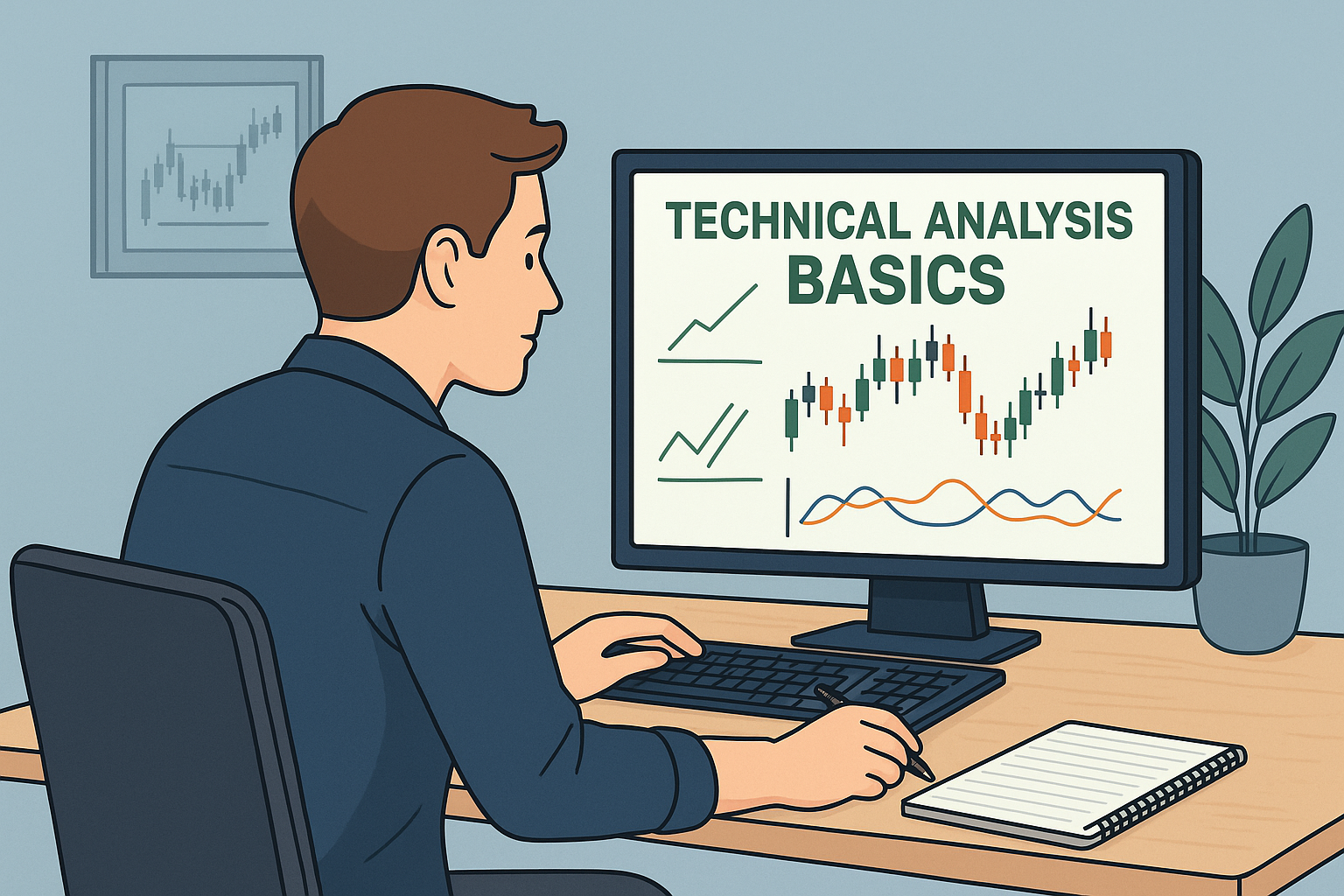
If you’ve ever wondered how traders predict price movements, the answer often lies in technical analysis. This method uses historical price data and chart patterns to forecast future market behavior.
In this guide, we’ll walk through the core concepts of technical analysis to help you build a solid foundation.
What Is Technical Analysis?
Technical analysis is the study of past price movements and trading volume to identify patterns and trends. Unlike fundamental analysis, which looks at economic indicators and company performance, technical analysis focuses purely on what’s happening on the chart.
Why traders use it:
- Identifies entry and exit points
- Helps time the market
- Works across all assets (forex, crypto, stocks)
📊 Fun fact: Technical analysis is especially popular in crypto because of its 24/7 nature and volatility.
Key Principles of Technical Analysis
1. Market Discounts Everything
All available information is already reflected in the price. News, earnings, economic data—everything is priced in. Traders believe that price alone reflects the full market picture.
2. Price Moves in Trends
Prices tend to move in identifiable trends: up, down, or sideways. The goal is to recognize these trends early and trade in their direction. Trends often persist longer than expected due to collective investor behavior.
3. History Repeats Itself
Because market participants often react in similar ways, patterns tend to repeat. Psychological behaviors like fear, greed, and herd mentality manifest through recurring patterns.
Understanding Price Trends
- Uptrend: Higher highs and higher lows signal sustained buying interest.
- Downtrend: Lower highs and lower lows suggest growing selling pressure.
- Sideways/Range-bound: When prices hover between support and resistance without clear direction.
Use trendlines to visually track these movements and help identify potential breakout or reversal points.
📈 Tip: Combine trend analysis with volume to assess the strength of a move.
Support and Resistance Basics
- Support: A price level where demand tends to stop a fall. Think of it as a floor.
- Resistance: A price level where supply tends to cap a rise. Think of it as a ceiling.
These zones are crucial for identifying trade setups and setting stop-loss or take-profit levels.
🧭 Strategy tip: Use historical highs/lows or Fibonacci retracement levels to identify key zones.
Must-Know Technical Indicators
Indicators help confirm what the price is telling you. They don’t predict—they guide.
- Moving Averages (MA): A simple way to smooth out price data and reveal the overall trend. Common types include the Simple Moving Average (SMA) and Exponential Moving Average (EMA).
- Relative Strength Index (RSI): Measures the speed and change of price movements. Values above 70 suggest overbought conditions, while below 30 suggest oversold.
- MACD (Moving Average Convergence Divergence): Helps spot changes in momentum and trend direction using a MACD line, signal line, and histogram.
- Bollinger Bands: Bands plotted around a moving average to highlight volatility and potential reversals when price touches outer bands.
🛠️ Use 2–3 complementary indicators for a balanced view. Avoid cluttering your charts.
Common Chart Patterns
Patterns visually represent market psychology. Learn to recognize them to anticipate possible outcomes.
- Head and Shoulders: A reversal pattern suggesting a trend change from bullish to bearish (and vice versa for the inverse).
- Triangles: Ascending, descending, and symmetrical triangles indicate consolidation before a breakout.
- Double Tops and Bottoms: These suggest potential reversals after a significant trend.
- Flags and Pennants: Short-term continuation patterns that signal a brief pause before the trend resumes.
📌 Pattern tip: Volume often decreases during the pattern and spikes at the breakout.
Volume Matters
Volume reflects the strength or weakness of a price move. It’s a critical confirmation tool.
- High volume during price moves supports the validity of that move.
- Low volume during breakouts or breakdowns may signal a false move.
Indicators like On-Balance Volume (OBV) and Volume Oscillator can enhance volume analysis.
Time Frames and Multiple Time Frame Analysis
Each chart time frame offers different insights:
- 1-minute to 15-minute: Good for scalping or quick intraday trades
- 1-hour to 4-hour: Popular among day traders and swing traders
- Daily to weekly: Used for position trading or broader trend analysis
🔍 Technique: Use a top-down approach—start with a higher time frame to determine trend, then move to lower time frames to find entries.
Risk Management and Technical Analysis
Technical analysis is powerful, but it’s not foolproof. Always pair it with solid risk management:
- Use stop-loss orders to protect your capital
- Position sizing based on risk per trade
- Stick to a risk/reward ratio of at least 1:2
💡 Remember: Even the best setups can fail. Consistent risk management ensures long-term survival.
Tools to Enhance Your Analysis
- TradingView: An industry-standard charting tool with powerful analysis features
- MetaTrader 4/5: Popular platforms for forex and CFD traders
- AITradingSignals.co: Offers data-driven trade signals and insights using AI models
🧠 Use alerts, watchlists, and templates to stay organized and efficient.
Final Thoughts: Build Your Charting Toolkit
Technical analysis is like learning a new language. Start with a few tools and concepts, and build from there. Consistent practice and smart tools—like AITradingSignals.co—can enhance your strategy and confidence.
Don’t worry about mastering everything at once. Just focus on spotting trends, identifying support/resistance, and practicing with indicators.
Ready to level up? Start marking up charts today and see what the price action is trying to tell you.