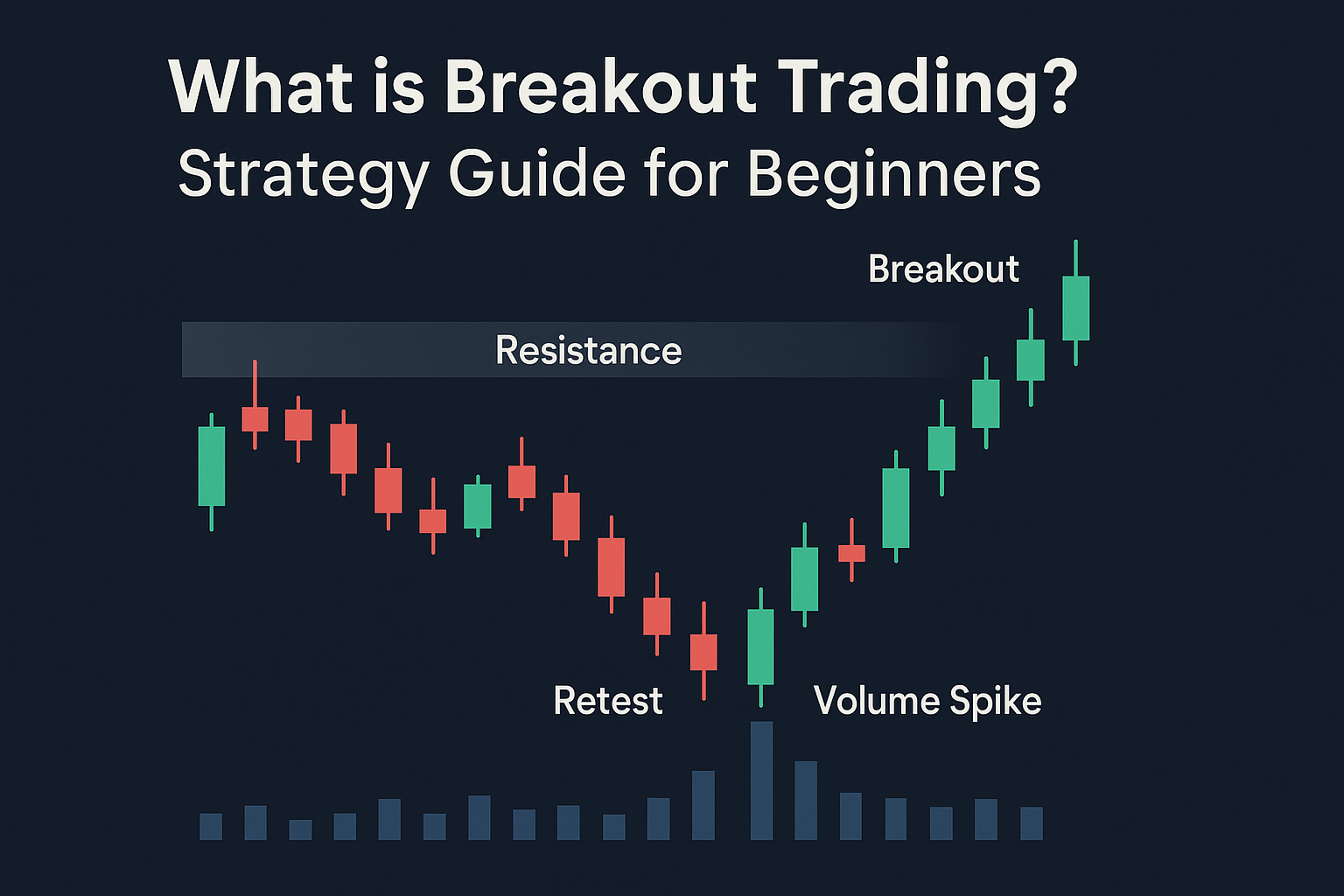
Breakout trading is a method that seeks to capitalize on moments when price “breaks out” of a defined region of support or resistance. As a beginner, you’re aiming to catch trends early—when price moves from a tight range or consolidation into a more directional move. If you’ve seen prices suddenly surge above a resistance line or drop below support, that was likely a breakout in action.
💥 What Is a Breakout in Trading?
A breakout happens when the price of an asset moves above a resistance level or below a support level, typically with increased momentum and trading volume.
- Bullish Breakout: Price breaches resistance and moves higher.
- Bearish Breakout: Price falls below support and tends to drop further.
- These breakouts often follow periods of consolidation or sideways movement (trading range).
🎯 Why Breakout Trading Works
Breakout trading tends to be effective because:
- It exploits momentum: once a breakout happens, many market participants jump in, accelerating the move.
- It often causes stop-loss triggers from traders positioned on the wrong side, adding fuel to the movement.
- There tends to be volume confirmation: higher trading volume during breakouts helps validate them.
- It gives clear risk/reward setup: support/resistance, stop, profit target are relatively well-defined.
🛠️ How to Trade Breakouts (Step‑by‑Step)
Step 1: Identify Key Levels
Mark horizontal support & resistance zones. Look for areas where price has touched several times. Use patterns like rectangles, triangles, trendlines.
Strong levels = more likely to act as barriers until broken.
Step 2: Wait for Break Confirmation
Don’t trade before the breakout closes (on your timeframe). Look for retests or follow‑through. Use volume or volatility expansion.
This prevents entering on false breakouts (“fakeouts”).
Step 3: Entry
Enter after the candle closes beyond resistance/support, or after a retest of the broken level. You can also trade the breakout of a pattern (triangle, flag, etc.).
Helps avoid getting whipsawed.
Step 4: Set Stop Loss
Place it just beyond the breakout level—below resistance for a bearish break, above support for a bullish break. Or use the pattern’s high/low.
This limits losses if the breakout fails.
Step 5: Set Take Profit / Exit Criteria
Use prior swing highs/lows, measure the height of a pattern (like a triangle) and project it forward, or use a fixed risk/reward ratio (e.g., 2:1, 3:1).
This ensures you exit with structure and discipline.
🧰 Useful Tools & Indicators
- Volume: Confirms validity of breakout.
- Volatility / ATR / Bollinger Bands: Show breakout potential.
- Chart Patterns: Triangles, flags, head & shoulders, rectangles.
- Momentum Indicators: RSI, MACD.
- Trend Strength Indicators: ADX.
⚠️ Common Mistakes & How to Avoid Them
Mistake: Entering too early
Why: FOMO, no confirmation.
Fix: Wait for candle close or retest.
Mistake: Ignoring fakeouts
Why: Weak volume or momentum.
Fix: Use confirmation tools like volume, indicators, and retests.
Mistake: Using too tight a stop-loss
Why: Volatility can shake you out.
Fix: Use ATR or give the trade more room beyond the breakout level.
Mistake: Chasing extended moves
Why: Entering too late.
Fix: Be disciplined. Enter early or wait for new setups.
Mistake: Lack of risk management
Why: Over-leveraging, no plan.
Fix: Always define your stop loss and position size in advance.
🤖 AI + Breakout Trading = Smart Alerts
AI or algorithmic trading platforms like AITradingSignals.co help by:
- Scanning multiple markets and timeframes to spot high‑probability breakout setups.
- Filtering with multi‑indicator logic (volume + volatility + pattern).
- Alerting you in real time so you can act quickly.
Bonus: Save time and eliminate bias by letting AI find breakout setups 24/7.
❓ FAQs for Beginners
What timeframes work best?
1‑hour, 4‑hour, and daily charts are popular. Shorter timeframes like 15min or 5min work too but can be noisier.
Are breakout strategies profitable?
Yes, especially when you use confirmation and manage risk properly. A solid risk/reward ratio can make even a 40% win rate profitable.
Which indicators help?
RSI, MACD, ATR, Bollinger Bands, ADX, and volume-based tools. Use them to support—not replace—price action.
How do I avoid fakeouts?
Wait for a candle close, use volume confirmation, consider retests, and avoid trading during low liquidity or major news events.
🚀 Final Thoughts
Breakout trading is beginner-friendly and can be highly effective. But mastering it takes discipline, patience, and good risk control. Start small, log your trades, and always define your entry, stop, and profit target before entering a position.
Want to skip the scanning and get breakout alerts in real time? Try AITradingSignals.co