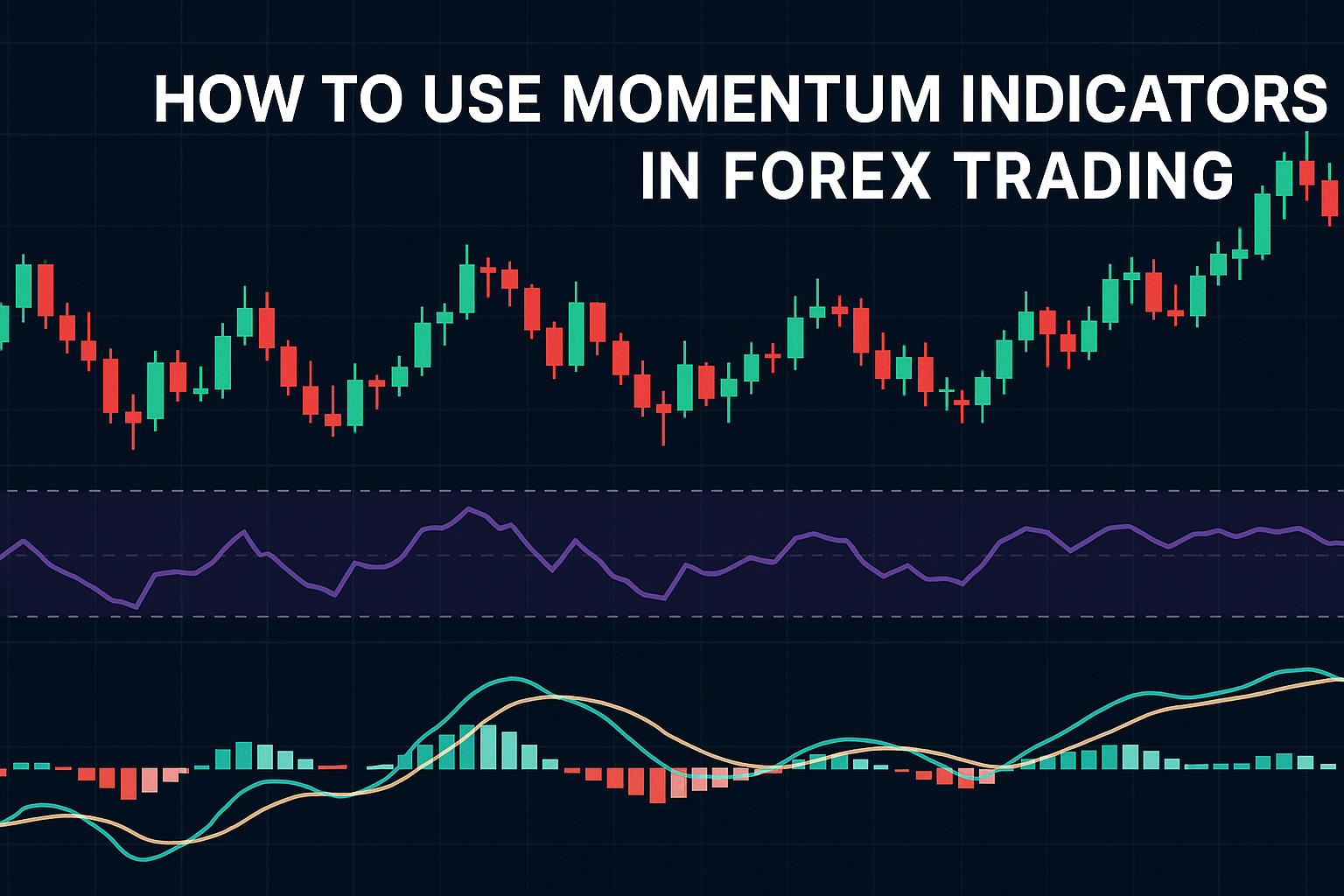
Momentum indicators help you see how fast price is moving and whether that push is fading or accelerating. Used correctly, they keep you from chasing weak moves and help you time entries on pullbacks or breakouts. This guide shows practical, testable ways to apply momentum tools—RSI, Stochastic, MACD, Rate of Change (ROC), and a pure Momentum line—along with risk rules, example settings, and algorithmic trading angles.
Promise: By the end, you’ll have clear rules for momentum‑based entries, exits, and filters that you can backtest in TradingView or your platform of choice.
Related reading on Indicators101:
- How to Set Stop‑Loss & Take‑Profit in Forex
- Risk Management 101: Position Sizing for Forex & Crypto
- How to Build & Backtest a Strategy in TradingView
- Indicators101: Beginner’s Guide to Algorithmic Trading
Momentum vs. Trend (Know the Difference)
- Trend describes direction (up, down, or range).
- Momentum describes pace. Price can be in an uptrend with waning momentum—a warning that pullbacks or reversals are likely.
A simple workflow: use a trend filter (e.g., 50/200 EMA) to define bias, then use momentum to time entries within that bias.
The Core Momentum Indicators (and What They’re Good For)
1) RSI (Relative Strength Index)
- What it measures: Speed of gains vs. losses over a lookback (default 14).
- Use cases: Pullback entries in trends; spotting divergences near key levels; momentum confirmation on breakouts.
- Common rules:
-
- In uptrends, look for RSI to pull back to 40–50 zone and then re‑cross above 50 for entries.
- In downtrends, look for RSI to bounce to 50–60 and then cross back below 50.
- Divergence: price makes higher high, RSI lower high → momentum warning.
2) Stochastic Oscillator (Full/K/D)
- What it measures: Where the close sits within the recent high‑low range (default 14,3,3).
- Use cases: Timing oversold/overbought turns inside established trends; range trading on higher timeframes.
- Common rules:
-
- In uptrends, buy when %K crosses above %D below 20–30; exit or take partials on crosses above 70–80.
- In downtrends, sell when %K crosses below %D above 70–80.
3) MACD (Moving Average Convergence Divergence)
- What it measures: Momentum via the spread between fast and slow EMAs (default 12/26 with 9 signal).
- Use cases: Momentum confirmation on breakouts; trend continuation after pullbacks; spotting zero‑line crosses that align with higher‑timeframe trend.
- Common rules:
-
- Trade zero‑line cross in the direction of the higher‑timeframe trend.
- Use signal‑line cross as a trigger only after a structure break.
4) ROC (Rate of Change)
- What it measures: Percentage change over N bars (e.g., ROC(10)).
- Use cases: Fast momentum bursts; breakout filters (e.g., only take breakouts when ROC is above X%).
5) Momentum (Classic Line)
- What it measures: Difference between current close and close N bars ago.
- Use cases: Simple above/below zero bias; can be smoothed to avoid noise.
Pro tip: Pick one primary momentum tool to start (RSI or MACD are popular) and add others only if they materially improve out‑of‑sample results.
Build a Momentum Workflow (Step‑by‑Step)
- Trend Filter: Define bias with 50/200 EMA or a higher‑timeframe EMA cross.
- Setup: Choose one of the patterns below (pullback or breakout).
- Trigger: Use momentum indicator rules to time the entry.
- Risk: Size from stop distance (0.5%–1.0% risk per trade recommended for learners).
- Exits: Use structure or ATR for stops; R‑multiples or key levels for targets; optional trailing.
- News/Session: Avoid low‑liquidity hours and high‑impact releases when appropriate.
Two Momentum Playbooks You Can Backtest
Playbook A — Trend Pullback + RSI Re‑Cross (Intraday or Swing)
Idea: Trade with the trend after a momentum reset.
- Trend: 50 EMA above 200 EMA for longs (reverse for shorts).
- Pullback: Price closes below the 20 EMA (uptrend) for at least one bar.
- Trigger: RSI(14) dips to 40–50 and then closes back above 50 → enter on next bar.
- Stop: Below the recent swing low or 1× ATR(14), whichever is farther.
- Targets: Take 50% at +1.5R, move stop to breakeven; exit remainder at +3R or trail by 1.5× ATR.
- Filters: No new entries 10 minutes before high‑impact news; trade only during London/NY sessions.
Why it works: You align with trend but wait for momentum to refresh before entering.
Playbook B — Breakout + MACD Zero‑Line Confirm (Session Momentum)
Idea: Enter only when a range break has confirmed momentum behind it.
- Range: Define a 10–20 bar range; price closes beyond range high/low.
- Trigger: MACD line crosses above zero (long) or below zero (short) within the last 3 bars.
- Stop: Opposite side of the range or 1.5× ATR, whichever is wider.
- Targets: Range height projected from the breakout (1–2×), plus optional trail.
- Filters: ATR below its 20‑bar average before entry (avoid news‑spike breakouts).
Why it works: It combines structure (range break) with rising momentum, filtering weak fake‑outs.
Parameter Guidance (Start Here, Then Test)
- RSI: 14‑period; trigger around 50 in trends (not 70/30). For ranges, 70/30 cross can work.
- Stochastic: 14,3,3; extreme zones 20/80; prefer cross + trend.
- MACD: 12/26/9 default; watch zero‑line with higher‑timeframe trend.
- ROC: 10 or 14; require ROC above a small positive threshold (e.g., >0.2%) on breakouts.
- Momentum: 10 or 14; above/below zero filter with smoothing (SMA 3–5).
Keep settings simple; optimize only within narrow, logical ranges.
Risk & Trade Management (Non‑Negotiable)
- Risk a fixed 0.5%–1.0% per trade while testing.
- Place stops where the setup is invalidated—beyond the swing or with an ATR buffer (0.5–1.5×).
- Use partial exits to smooth equity: e.g., take 40%–50% at +1.5R and trail the rest.
- Impose daily/weekly loss limits (e.g., −3R/day). If you hit it, stop trading.
Momentum Mistakes to Avoid
- Buying “overbought” in a weak trend or selling “oversold” in a strong trend without a trend filter.
- Signal stacking (RSI + Stoch + MACD + CCI) until it’s overfit.
- Ignoring regime shifts: Momentum rules tuned for quiet ranges fail in volatile news cycles.
- Repainting illusions: Always test on closed candles; don’t rely on real‑time indicator wiggles.
Backtesting Your Momentum Rules (Simple Workflow)
- Write the rules exactly (entries, exits, filters, session windows).
- Include costs (spread, commission, slippage). Momentum entries near breakouts can slip.
- Test across multiple regimes (trend/range, high/low volatility) and pairs (EURUSD, GBPUSD, USDJPY, etc.).
- Validate with out‑of‑sample periods and consider walk‑forward if you tweak parameters.
- Forward test on paper or tiny size for 2–6 weeks; compare live stats to backtest.
If an improvement vanishes out‑of‑sample, discard it. Simpler is safer.
Algorithmic & AI Trading Angle
- Automation: Encode your momentum rules in Pine Script or MQL so bots execute without hesitation.
- Regime labels: Use a simple ML classifier (trend/range/volatile) to select which momentum playbook is active; keep the entry/exit rules deterministic.
- Risk router: Centralize position sizing and exposure caps so momentum strategies don’t stack correlated risk.
- Monitoring: Track expectancy by session and ATR percentile; disable when the edge collapses.
Practical Examples (Numbers Included)
Example 1: EURUSD H1 — Pullback + RSI Re‑Cross
- Account $10,000; risk 0.75% ⇒ $75
- Trend up (50>200); price pulls under 20 EMA; RSI drops to 45 then closes back >50.
- Entry at 1.0920; stop at swing low 1.0890 (30 pips) → with $75 risk, size ≈ $2.5/pip (0.25 lots on majors).
- Target 1 at +1.5R (45 pips); trail remainder by 1.5× ATR.
Example 2: GBPUSD M30 — Breakout + MACD Zero‑Line
- Range height 28 pips; MACD crosses above zero; breakout close at 1.2760.
- Stop at range low 1.2732 (28 pips) or 1.5× ATR if larger.
- TP at 1× range (28 pips); optional runner with ATR trail.
FAQs
Which momentum indicator is best for forex?
None universally. Start with RSI for trend pullbacks or MACD for breakout confirmation and test.
What RSI settings work for day trading?
RSI(14) with 50‑level re‑cross in the direction of trend is a good baseline; avoid 70/30 in strong trends.
Can momentum indicators work alone?
They’re stronger with a trend filter and clear risk rules. Price structure still matters.
How do I avoid false signals?
Use session/news filters, ATR/volatility thresholds, and require structure confirmation (range break, swing reclaim) in addition to the indicator.
Can I automate momentum strategies?
Yes. Pine/MQL can implement all rules. Start with alerts → semi‑auto → careful automation. Track slippage.
Summary & Next Steps
Momentum indicators are most powerful when they time entries inside a defined bias with explicit risk rules. Choose one playbook, write rules you can test, and measure results by expectancy and drawdown, not just win rate. When ready, automate the parts that benefit from speed and discipline.
Keep learning on Indicators101:
- How to Build & Backtest a Strategy in TradingView
- How to Set Stop‑Loss & Take‑Profit in Forex
- Risk Management 101: Position Sizing for Forex & Crypto
Call to Action: Ready to trade momentum with confidence? Give our Indicators a try at AITradingSignals.co for clean momentum entries and risk tools. Prefer a guided path? Check out our courses at aitradingsignals.gumroad.com for step‑by‑step strategies and backtesting labs.
Compliance & Disclaimer: This educational material is not investment advice. Trading involves risk, including possible loss of principal. Past performance does not guarantee future results. Ensure any images or charts you publish are original or properly licensed.