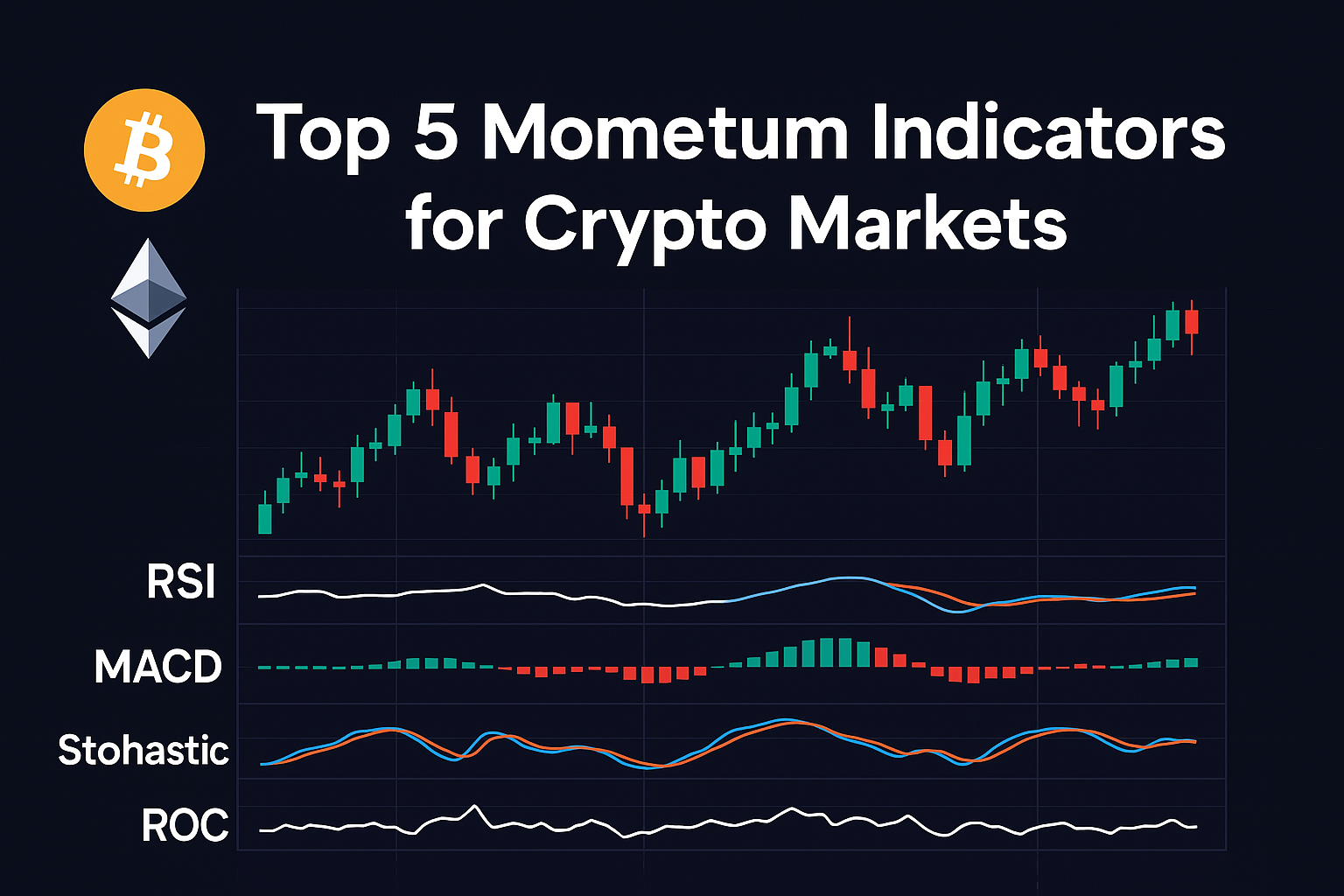
Crypto trades 24/7 and whipsaws fast. Momentum indicators help you judge the force behind price moves so you can avoid chasing exhausted pumps or holding through fading trends. Used with a trend bias and risk rules, they provide clear, testable entries and exits you can automate.
Promise: By the end, you’ll know five proven momentum tools—RSI, MACD, Stochastic, ROC, and ADX/DI—with starter settings, trade playbooks, risk management, and backtesting steps that work for BTC, ETH, and top alts.
Related reading on Indicators101:
- How to Use Momentum Indicators in Forex Trading
- How to Build & Backtest a Strategy in TradingView
- Risk Management 101: Position Sizing for Forex & Crypto
- Indicators101: Beginner’s Guide to Algorithmic Trading
Ground Rules Before You Apply Momentum
- Always define trend first. Use a simple filter like 50 EMA vs. 200 EMA or higher‑timeframe market structure.
- Risk first. Size positions from stop distance; risk 0.25%–1.0% per trade while learning.
- Use closed candles. Generate signals on confirmed bars to avoid intrabar whipsaws.
- Respect regimes. What works in quiet ranges often fails during news‑driven spikes (ETF decisions, protocol upgrades, halving narratives).
- Backtest, then forward test. Don’t skip validation; crypto’s volatility exaggerates untested ideas.
Indicator #1 — RSI (Relative Strength Index)
What it does: Measures speed of gains vs. losses over a lookback (default 14). In crypto, RSI is great for trend pullback timing and momentum divergences.
Starter settings: RSI(14) on H1/H4 for swings; RSI(7–10) on M15/M30 for intraday. Use the 50‑level as a bull/bear line.
Long‑bias rules (uptrend only):
- Trend filter: 50 EMA > 200 EMA or daily structure higher highs/lows.
- Wait for RSI to dip into 40–50 zone and re‑cross above 50.
- Enter on next bar close.
- Stop: Below recent swing or 1× ATR(14); choose the wider.
- Targets: 50% at +1.5R, trail remainder with 1.5× ATR or structure.
Short‑bias (downtrend only): Mirror rules around RSI 50 from above.
When it shines: Pullbacks during strong trends (BTC/ETH post‑breakout runs).
Common mistake: Using 70/30 reversals against a powerful trend—leads to serial stopouts.
Indicator #2 — MACD (Moving Average Convergence Divergence)
What it does: Tracks the distance between a fast and slow EMA (12/26 default) and a 9‑period signal. MACD captures trend momentum and shift in acceleration.
Starter settings: 12/26/9 on H1/H4/D1.
Breakout confirmation playbook:
- Define a range (lookback 10–20 bars). Wait for a close outside the range.
- Require the MACD line to cross above zero (long) or below zero (short) in the last 3 bars.
- Stop: Opposite side of the range or 1.5× ATR.
- Target: 1–2× the range height; keep a runner with an ATR trail.
Momentum continuation playbook:
- In trend, enter on signal‑line cross after a pullback, but only in the direction of the zero‑line side (above zero for longs, below for shorts).
When it shines: Session‑driven expansions (Asia to U.S. handoff), strong news trends (ETF approvals, mainnet launches).
Common mistake: Taking every signal‑line cross in choppy ranges—filter with trend and volatility.
Indicator #3 — Stochastic Oscillator (Full 14,3,3)
What it does: Shows where the close sits within the recent high‑low range. In crypto, Stoch shines for timing rotations inside trends.
Starter settings: 14,3,3; zones at 20/80.
Trend pullback trigger:
- Uptrend: When price retraces, look for %K crossing above %D below 20–30. Enter on close.
- Stop: Beneath pullback swing or 1× ATR.
- Targets: Partial at +1–1.5R; trail by structure.
Range strategy:
- When the higher timeframe is flat, consider fading edges: sell %K cross‑down above 80, buy cross‑up below 20. Keep targets tight; use hard stops.
When it shines: Alts with sharp mean‑reverting patterns during quiet sessions.
Common mistake: Treating overbought/oversold as automatic reversal signals in strong trends.
Indicator #4 — ROC (Rate of Change)
What it does: Measures percentage price change over N bars, e.g., ROC(10). Great for detecting momentum bursts and filtering breakouts.
Starter settings: ROC(10) or ROC(14) with a small positive/negative threshold.
Breakout filter:
- Trade range breaks only when ROC > +0.3% (long) or < −0.3% (short) at the breakout bar.
- Combine with MACD or trend filter for fewer fake‑outs.
Scaling rule:
- If ROC exceeds +1% on entry (for intraday), consider taking quicker partials; momentum bursts often mean more slippage and snapbacks.
When it shines: News‑adjacent moves, initial legs after consolidation, microstructure shifts on liquid pairs (BTC/ETH).
Common mistake: Setting thresholds too high and missing valid early entries; test per timeframe/pair.
Indicator #5 — ADX/DI (Average Directional Index & Directional Movement)
What it does: ADX measures trend strength; +DI and −DI measure directional moves. ADX doesn’t tell direction—just how strong the move is.
Starter settings: ADX(14); use +DI and −DI lines.
Strength filter:
- Only take trend trades when ADX > 20–25.
- For longs: +DI > −DI and rising; for shorts: −DI > +DI and rising.
Entry idea:
- Combine with RSI pullback: enter only if ADX confirms strength to avoid low‑energy trends.
Exit idea:
- When ADX rolls over from high values, consider tightening a trail—momentum may be fading even if price hasn’t reversed yet.
When it shines: Trending phases after structural breaks on higher timeframes.
Common mistake: Using ADX alone as a signal; treat it as a filter or context measure.
Two Complete Crypto Momentum Playbooks
Playbook 1 — BTC/ETH Trend Pullback (RSI + ADX)
Idea: Buy pullbacks only when trend strength is adequate.
- Bias: 50 EMA > 200 EMA on H1 or H4; ADX(14) > 20.
- Trigger: RSI(14) dips to 40–50, then closes back above 50.
- Entry: Next bar close.
- Stop: Swing low − 1× ATR(14) (wider of the two).
- Targets: 50% at +1.5R; trail remainder with 1.5× ATR or last higher low.
- Risk: 0.5% per trade; halt for day at −3R.
Why it works: You align with trend, require energy (ADX), and time the pullback using RSI momentum reset.
Playbook 2 — Altcoin Breakout (MACD + ROC)
Idea: Enter breakouts only when momentum expands.
- Bias: Neutral; focus on clean base ranges.
- Setup: 10–20 bar tight range; ATR below its 20‑bar average.
- Trigger: Close outside range and MACD line above zero (for longs) with ROC(10) > +0.3% on the same bar.
- Stop: Opposite side of range or 1.5× ATR.
- Targets: Range height × 1–2; optional runner with ATR trail.
- Risk: 0.25%–0.5% (alts move fast). Stand aside near major news or listing events.
Why it works: Momentum confirmation filters weak breaks; ATR compression sets up expansions.
Parameter Starting Points (Adjust in Tests)
- RSI: 14 for swings, 7–10 for intraday; focus on 50‑level re‑cross.
- MACD: 12/26/9; watch zero‑line more than every signal cross.
- Stochastic: 14,3,3; zones 20/80; use cross + trend.
- ROC: 10–14; thresholds ±0.2–0.5% depending on timeframe/liquidity.
- ADX: 14; strength threshold 20–25; direction from +DI/−DI.
Keep ranges tight and logical; prefer robustness to perfection.
Risk Management for Crypto Momentum
- Per‑trade risk: 0.25%–0.75% on alts; 0.5%–1.0% on BTC/ETH when starting.
- Stop placement: Structure + ATR buffer (0.5–1.5×). Never widen after entry.
- Slippage & fees: Assume worse fills around breakouts and illiquid hours. Model fees/funding on perps.
- Exposure caps: Limit total long‑beta exposure across BTC/ETH/alts. Example: Max 3% open risk and no more than two highly correlated alts at once.
- Circuit breakers: Stop trading after −3R day or −6R week; review before resuming.
Backtesting & Forward Testing (Crypto‑Aware)
- Write rules precisely (entries, stops, TP, filters, sessions).
- Model costs: exchange fees, maker/taker, likely slippage, and funding.
- Test across regimes: bull, bear, range; include high‑volatility news months.
- Use out‑of‑sample periods and a small parameter grid; avoid curve‑fitting.
- Paper trade or use minimal size for 2–6 weeks; compare live stats to backtests.
Key metrics: Profit factor (>1.2 to start), expectancy (R/trade), max drawdown, average trade, and number of trades.
Algorithmic & AI Trading Angle
- Automation: Encode playbooks in Pine/MQL/Python. Let bots enforce entries/exits and risk caps.
- Regime detection: Simple ML labels (trend/range/volatile) can switch between playbooks or pause trading during chaos.
- Signal aggregation: Combine two independent momentum confirms (e.g., ROC + MACD) for fewer trades but higher quality.
- Monitoring: Build dashboards showing ATR percentile, ADX, and win rate by session. Halt when metrics fall below thresholds.
Practical Examples (Numbers Included)
Example A — ETHUSDT H1 (RSI Pullback)
- Equity $10,000; risk 0.5% ⇒ $50.
- Stop distance 15$; position size = $50 ÷ 15$ ≈ $3.33 per $ move (adjust to exchange contract rules).
- Entry on RSI(14) re‑cross above 50 in uptrend; stop under swing − ATR buffer.
- TP1 at +1.5R; trail remainder with 1.5× ATR.
Example B — SOLUSDT M30 (MACD + ROC Breakout)
- Base height 1.2%; ROC(10) at breakout = +0.5%; MACD above zero.
- Risk 0.25% per trade; stop at base low (or 1.5× ATR if wider).
- TP at 1.2–2.4% move; runner trailed by ATR.
Example C — BTCUSD H4 (ADX Filtered Trend)
- ADX(14) rises through 25 with +DI > −DI; buy first RSI pullback.
- Risk 0.75%; take partials at +1.5R; trail by structure higher lows.
Momentum Mistakes Unique to Crypto
- Chasing social pumps without ROC/MACD confirmation.
- Ignoring funding/fees on perps—slow bleed can ruin edge.
- No liquidity filter on small‑cap alts—slippage invalidates backtests.
- 24/7 fatigue trading—set session windows or automation to avoid degraded decisions.
FAQs
Which momentum indicator works best for crypto?
There’s no universal winner. Start with RSI for pullbacks and MACD/ROC for breakouts, then test per asset/timeframe.
What timeframes are best?
H1/H4 for swing clarity; M15–M30 for intraday. Use higher‑timeframe trend with lower‑timeframe triggers.
How do I avoid false breakouts?
Require momentum confirmation (MACD above/below zero, ROC threshold) and trade from ATR compression.
Can I automate these strategies?
Yes. Pine/MQL/Python can implement all rules and risk guards. Start semi‑auto with alerts.
What risk should I use on alts?
Smaller than BTC/ETH—start 0.25%–0.5% per trade due to volatility and slippage.
Summary & Next Steps
Momentum isn’t about buying every green candle—it’s about evidence of force aligned with structure and controlled risk. Pick one playbook (RSI pullback or MACD+ROC breakout), write the rules, test across regimes, and automate the execution as you gain confidence. Use ADX as a strength filter and Stoch for timing inside trends when conditions are calm.
Keep learning on Indicators101:
- How to Use Momentum Indicators in Forex Trading
- How to Build & Backtest a Strategy in TradingView
- Risk Management 101: Position Sizing for Forex & Crypto
Call to Action: Ready to trade momentum with consistency? Give our Indicators a try at AITradingSignals.co for clean momentum entries and risk tools.
Prefer a guided path? Check out our courses at aitradingsignals.gumroad.com for step‑by‑step strategies and backtesting labs.
Compliance & Disclaimer: This educational material is not investment advice. Crypto trading involves risk, including possible loss of principal. Past performance does not guarantee future results. Ensure any images or charts you publish are original or properly licensed.