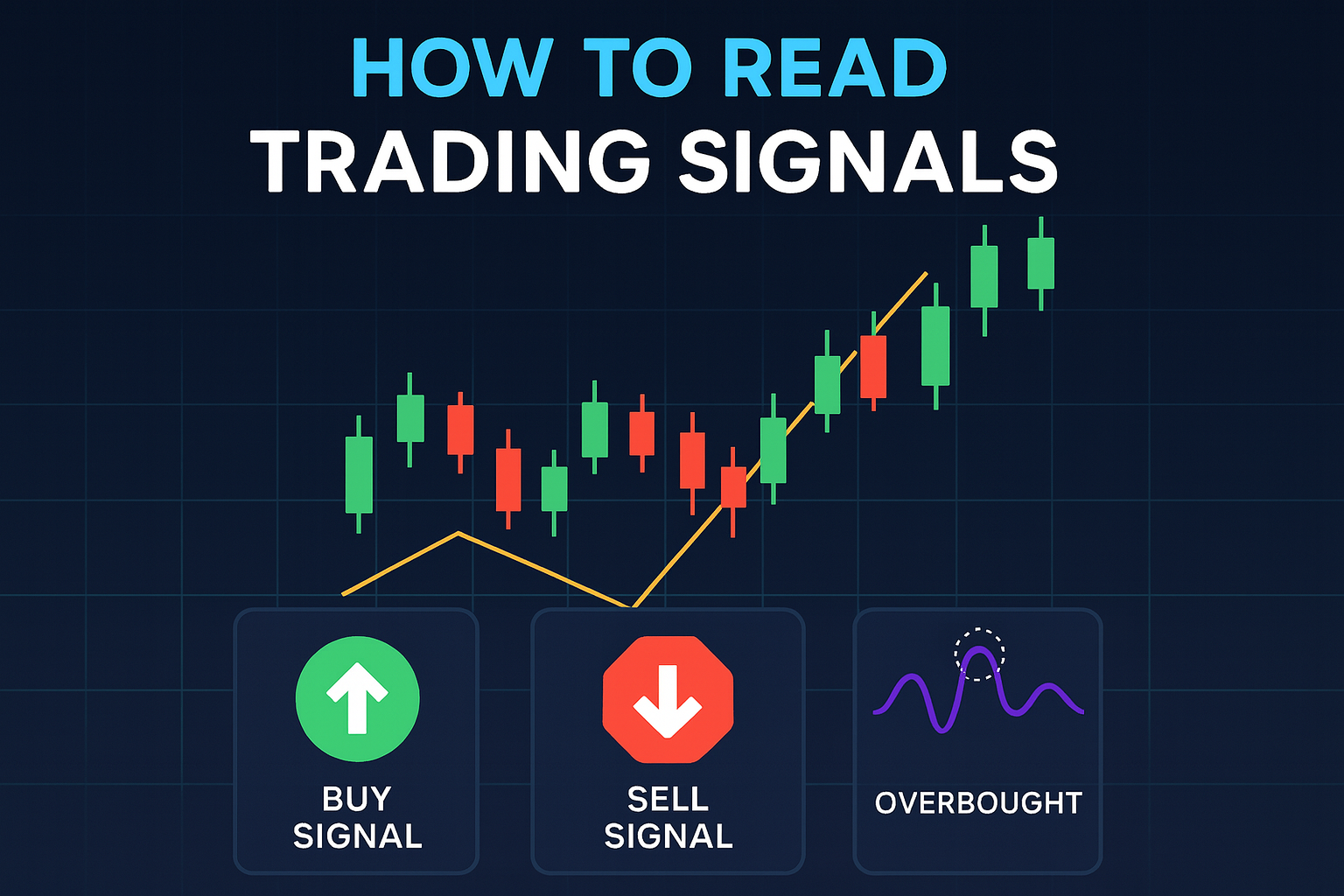
Trading signals are shortcuts to decision‑ready ideas. But signals are only as good as your ability to read them—context, rules, and risk. This guide shows exactly how to parse a signal, validate it on TradingView, and execute with discipline.
We’ll also cover how AI trading and algorithmic trading signals fit into a professional workflow.
🎯 What Is a Trading Signal?
A trading signal is a structured instruction to buy/sell an asset under specific conditions. A complete signal should include:
- Direction: Long or Short
- Entry: Price or rule (e.g., “on 20 EMA retest”)
- Stop‑Loss (SL): Price or rule (e.g., “below swing low”)
- Take‑Profit (TP): Price levels or R‑multiples (e.g., 1.5R, 2R)
- Timeframe: e.g., 1H, 4H, Daily
- Rationale: Indicators/patterns/news behind the idea
- Validity: When the setup is invalid (e.g., breaks structure)
Red flag: Signals that lack SL/TP or timeframe create ambiguity. Skip them.
🧭 The 5‑Step Framework to Read Any Signal
- Identify Context
- Trend bias with 20/50 EMA or market structure (HH/HL vs. LH/LL)
- Session/volatility (London/NY for forex; major news)
- Key levels (daily/4H S/R, liquidity zones)
- Decode the Rules
- Which indicators? (RSI/MACD/EMAs/Fibs)
- What trigger? (candle close above level, RSI cross 30→up, MACD cross)
- Is it market or limit entry? Any confirmation requirement?
- Quantify Risk
- Fixed SL (pips/points) or structural SL (below swing)
- Position size via % risk model (e.g., 0.5–1% per trade)
- Risk‑to‑Reward (R:R)—is the target ≥ 1.5R–2R?
- Check Confluence
- Trend + level + trigger + momentum alignment
- Avoid trades into nearby opposing levels or during high‑impact news
- Plan Management
- How to move to break‑even (e.g., after 1R reached)
- Partial profit or full at target?
- Clear invalidations—when to exit early

📜 Example Signals (and How to Read Them)
1) RSI + 20 EMA Pullback (Crypto, 1H)
- Signal: Long BTCUSD on 20 EMA retest; RSI 35→up, bullish close; SL below swing; TP 2R.
- Read it: Trend up? Is resistance close? Place limit at EMA zone; confirm candle close; size for 1% risk.
- Why it works: Combines trend, mean reversion, and momentum turn.
2) MACD Zero‑Line Shift (Forex, 4H)
- Signal: Long EURUSD when MACD histogram flips positive with higher low; SL under last HL; TP at prior high (≈1.8R).
- Read it: Ensure higher‑timeframe (D1) is neutral/up; avoid ECB/US CPI releases.
3) Break‑and‑Retest of Key Level
- Signal: Short on retest of broken support turned resistance; bearish engulfing confirmation; SL above wick; TP to daily demand zone.
- Read it: Draw the level on 4H/D1; watch for liquidity sweep; check spread/volatility.

🤖 AI Trading & Algorithmic Signals: How They Fit
AI trading tools scan thousands of bars across markets to surface setups that match your rule set. Algorithmic trading converts those rules into code for consistency.
Benefits:
- Speed: Alerts fire the moment conditions are met
- Consistency: Objective, rules‑based entries
- Learning: Transparent criteria help you improve faster
Use with TradingView:
- Receive signal → jump to TradingView chart → verify trend/levels → check R:R → execute or skip
- Keep your human veto: pass on low‑quality context even if rules fire
Where to get our signals & code:
- Site: Full source code + step‑by‑step guide → https://www.aitradingsignals.co/
- Gumroad: Full script + market‑specific course material (forex or crypto) + step‑by‑step guide for precise rule sets → https://aitradingsignals.gumroad.com/
There’s no free trial. Choose the path that matches how hands‑on you want to be.
🧪 Validate Signals Before You Risk Real Money
- Backtest: Quickly test on historical data to see baseline stats
- Forward test (paper/demo): Run for 2–4 weeks to measure live behavior
- Track win rate, average R, max drawdown, expectancy
Expectancy formula:
(WinRate × AvgWin) – (LossRate × AvgLoss)
Positive expectancy over a meaningful sample (>50 trades) is key.
⚠️ Common Pitfalls (and Fixes)
- Chasing every alert: Pre‑define A/B setups; ignore C‑grade signals
- No SL/TP: Always set structural SL and pre‑planned targets
- Oversizing: Risk a fixed %; avoid martingale
- News landmines: Use an economic calendar; pause around high‑impact events
- Signal latency/slippage: Prefer limit orders at levels; widen SL slightly on illiquid pairs
📈 Position Sizing Mini‑Guide
- Decide account risk (e.g., 0.5–1% per trade)
- Calculate stop distance (pips/points)
- Size so that Risk = Account × %
- Confirm fees/spread don’t crush R:R
Use a position‑size calculator or script to avoid arithmetic errors.
🔄 Managing the Trade
- Move to break‑even after price reaches +1R and structure supports it
- Scale out 25–50% near first target; let runners aim for higher R
- Journal screenshots before/after; tag signal type; review weekly
🧠 Signal Quality Scorecard (0–10)
Score each dimension 0–2 (sum = 10):
- Trend alignment
- Level quality (freshness, HTF significance)
- Trigger clarity
- R:R potential
- News risk / liquidity
Treat ≤6/10 as pass‑only‑with‑care; 8–10/10 as A‑setups.
✅ Pros & Cons of Trading Signals
Pros
- Speeds up idea discovery
- Objective rules reduce emotion
- Easier to journal and optimize
Cons
- Poor signals lead to overtrading
- Latency, spread, and slippage can hurt results
- Blind copying = hidden risk; always verify context
🧭 10‑Minute Pre‑Trade Routine (Template)
- Check calendar (red‑flag news?)
- Mark daily/4H levels
- Review watchlist and pending alerts
- Score signal (0–10)
- Confirm R:R ≥ 1.5
- Set order + alert
- Journal plan
- Walk away—let alerts work
❓ FAQs: How to Read Trading Signals
Are paid signals worth it? Only if they’re transparent (rules/SL/TP) and you validate results with your own testing.
What’s a good win rate? It depends on R:R. A 40% win rate is fine if average win is 2R and losses are 1R.
Should I take every signal? No. Filter by trend/levels/news and your scorecard.
Can beginners use AI trading signals? Yes—if you keep position sizes small and always cross‑check on TradingView.
What timeframe is best? 1H–4H balances noise and clarity for most beginners; scalp only after you’re consistent.
📌 Summary
Reading trading signals isn’t about copying calls—it’s about decoding rules, measuring risk, and enforcing discipline. Use confluence, demand at least 1.5R, and keep a written plan. Layer AI trading and algorithmic trading signals to scale your scanning while you stay in control of confirmation and execution.
Next step:
- Get our signals + code and follow the step‑by‑step guide → https://www.aitradingsignals.co/
- Prefer a packaged path with market‑specific course material (forex or crypto)? → https://aitradingsignals.gumroad.com/
🔒 Compliance & Risk Disclosure
This content is for educational purposes only and is not financial advice. Markets are risky. Backtest, forward test, and never risk money you can’t afford to lose. We don’t provide personalized recommendations.