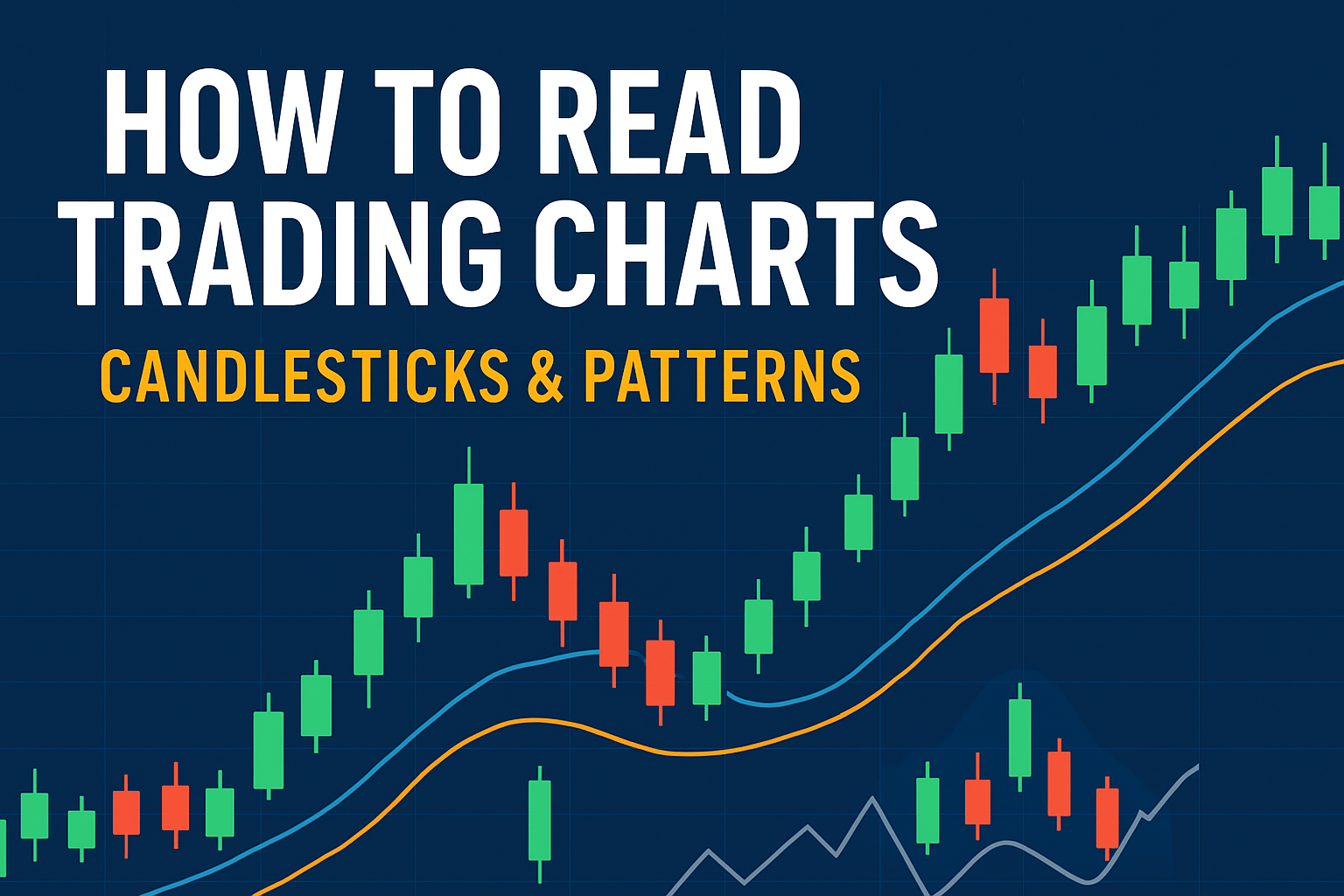
Ever looked at a trading chart and felt lost? You’re not alone. Trading charts can seem like a maze of lines and colors, but once you understand the basics, they become your best tool for spotting opportunities.
This guide breaks down candlestick charts, common patterns, and key indicators so you can read the market like a pro.
What Are Trading Charts?
A trading chart is a visual representation of price movements over time. Traders use charts to identify trends, time entries, and manage risk.
The most common chart types are:
- Line Chart: Connects closing prices with a line. Simple but limited.
- Bar Chart: Shows open, high, low, and close (OHLC) prices.
- Candlestick Chart: The most popular, showing the same OHLC data with clearer visuals.
Candlestick charts are the go-to for most forex and crypto traders.
Understanding Candlestick Components
Each candlestick shows price action for a set time period (e.g., 1 hour, 1 day):
- Body: The box between open and close prices.
- Wick (Shadow): The lines above and below the body, showing highs and lows.
- Color: Often green (bullish) for up and red (bearish) for down.
📌 Example: A green candle with a long lower wick suggests buyers pushed the price back up after sellers tried to drive it down.
How to Spot Trends with Charts
Trends help you trade in the direction of momentum. Look for:
- Higher highs and higher lows = Uptrend
- Lower highs and lower lows = Downtrend
- Sideways movement = Ranging or consolidating market
Use trendlines to connect highs/lows and confirm the trend.
📈 Visualization tip: Draw a line connecting higher lows in an uptrend for clarity.
Popular Candlestick Patterns
Certain candlestick combinations signal potential market moves:
Bullish Patterns
- Hammer: Small body, long lower wick (often after a downtrend)
- Engulfing: A green candle fully engulfs the red one before it
- Morning Star: Three candles signaling a reversal from down to up
Bearish Patterns
- Shooting Star: Small body, long upper wick (after an uptrend)
- Engulfing: A red candle swallows the green one before it
- Evening Star: Three candles signaling a reversal from up to down
🔥 Pro tip: Patterns are more reliable near key support or resistance zones.
Using Support and Resistance
- Support: A price level where buying interest tends to push the price up
- Resistance: A level where selling pressure tends to push the price down
These levels often align with previous highs and lows, making them vital reference points for entry and exit.
💡 Combine support/resistance with candlestick patterns for high-probability trades.
Key Chart Indicators to Know
Technical indicators help confirm trends and spot momentum shifts:
- Moving Averages (MA): Smooth out price to reveal direction
- Relative Strength Index (RSI): Shows overbought/oversold conditions
- MACD (Moving Average Convergence Divergence): Tracks momentum and trend shifts
- Volume: Indicates the strength behind a price move
🛠️ Use indicators with price action—not in isolation.
Practice Reading Charts Daily
- Use demo accounts or charting tools like TradingView
- Focus on one time frame (e.g., 1-hour) at first
- Mark patterns and draw trendlines to build muscle memory
🎯 Set a goal: Identify 3 chart patterns per day to sharpen your skills.
Final Thoughts: Candles Tell the Story
Trading charts are more than visuals—they’re a language of price action. Once you learn to read candlesticks and patterns, you unlock a new level of market insight. Combine your knowledge with consistent practice and smart tools like AITradingSignals.co to boost your trading edge.
Start slow, keep learning, and let the charts guide your next move.