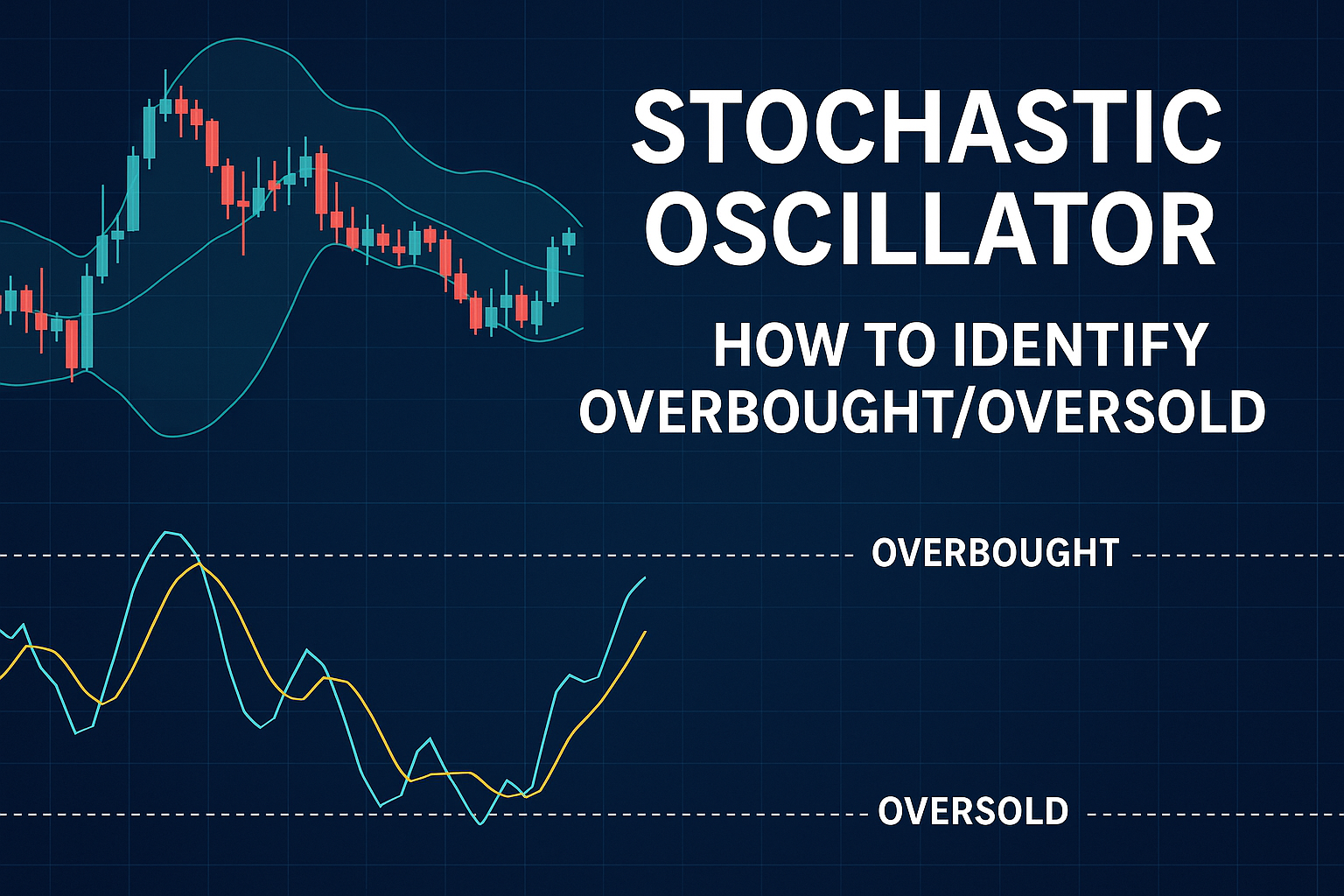
The Stochastic Oscillator is a compact momentum tool that helps you spot potential reversals and timed entries inside ranges and pullbacks. Because it compares the close to the recent high–low range, it often turns before price breaks structure—giving you an early look at exhaustion and where a bounce could start. Used with clean price levels and risk rules, it’s one of the simplest ways to build a rules‑based edge you can backtest and automate.
Promise: In this practical guide you’ll learn how Stochastics work, how to read them, and how to apply them with two complete trading playbooks—plus parameter tips, risk settings, and AI/automation ideas.
Related on Indicators101:
- Price Action Trading Basics (Support/Resistance Breakouts)
- How to Use Momentum Indicators in Forex Trading
- Using Volume Indicators to Confirm Breakouts
- How to Build & Backtest a Strategy in TradingView
What Is the Stochastic Oscillator?
Created by George Lane, the Stochastic Oscillator compares the current close to the range (high–low) over a lookback window. It outputs two lines:
- %K – the fast line (raw Stochastic)
- %D – a 3‑period moving average of %K (the signal line)
Default settings: %K = 14, %D = 3 (smoothing can vary by platform). Values range from 0 to 100.
Interpretation:
- Above 80 → Overbought zone (momentum has run hot)
- Below 20 → Oversold zone (momentum has cooled)
Important: Overbought/oversold are zones of interest, not automatic reversal calls. Strong trends can keep Stoch elevated or depressed for long stretches.
How to Read Stochastics (Step‑by‑Step)
- Identify context first. Is price trending or ranging? Use a simple filter like 50/200 EMA or higher‑timeframe swing structure.
- Locate the zone. Is Stoch in <20 (oversold) or >80 (overbought)? Mark the potential setup.
- Watch the cross. The key timing cue is the %K line crossing the %D line.
- Bullish: %K crosses above %D below 20 → possible bounce.
- Bearish: %K crosses below %D above 80 → possible drop.
- Look for confluence. Support/resistance, trendlines, prior day/week high‑low, or candlestick rejection add quality.
- Confirm or filter. Simple confirmations like RSI > 50 (for longs), MACD above/below zero, or RVOL can reduce false signals.
Overbought & Oversold—Without the Myths
- In ranges: Overbought/oversold zones are your hunting grounds. Combine with a rejection candle or range edge for entries.
- In trends: Treat extreme zones as pullback timing tools, not reversal proclamations. In uptrends, prefer oversold → bullish cross; in downtrends, prefer overbought → bearish cross.
- Example: If BTCUSD is trending down and Stoch is <20, don’t buy blindly; wait for a bullish structure break or reclaim (e.g., close back above a level/VWAP) and a %K>%D cross to time the bounce.
Divergence: Your Early‑Warning Radar
Stochastics can diverge from price:
- Bullish divergence: Price makes lower lows while Stoch makes higher lows → downside momentum losing steam.
- Bearish divergence: Price makes higher highs while Stoch makes lower highs → upside momentum stalling.
How to trade it: Use divergence as a setup alert, then wait for a trigger (e.g., %K>%D cross plus a price reclaim/structure break). Divergence without confirmation is just a hint.
Settings That Actually Help (Start Here)
- 14,3,3 (Full Stoch) for swing clarity on H1–D1.
- 7–10,3,3 for intraday sensitivity (M15–M30). More signals, more noise.
- 21,3,3 to smooth choppy assets or higher timeframes.
Tune only inside tight, logical ranges. If your edge disappears when you change %K by ±2, it’s overfitted.
Risk Comes First (Simple, Repeatable)
- Per‑trade risk: Start 0.5%–1.0% on majors/BTC/ETH; 0.25%–0.75% for volatile alts or minors.
- Stops: Place beyond the invalidating structure (below rejection low for longs / above rejection high for shorts) plus an ATR(14) buffer (0.3–1.5× depending on timeframe/liquidity).
- Exits: Take 40–50% at +1.5R, move stop to breakeven, then trail by 1.5× ATR or last swing. This keeps losers small and lets winners run.
Two Complete Stochastic Playbooks (Copy/Paste Rules)
Playbook A — Range Rotation with Stoch Cross (M15–H1)
Idea: Fade range edges using Stoch timing and price confirmation.
Rules (long example):
- Range identified with at least 3 touches on each side; ATR(14) is below its 20‑bar SMA (compression).
- Price tests range support and prints a rejection candle (pin/engulfing) or reclaims VWAP.
- Stoch <20 and %K crosses above %D on the same or next bar.
- Enter long on the close.
- Stop: Below the rejection low − 0.5× ATR.
- Targets: Mid‑range first; then opposite edge; or +1.5R / +3R with optional ATR trail.
- Guards: No trades 10–15 minutes before high‑impact news; avoid thin liquidity windows.
Why it works: You trade mean‑reversion inside a well‑defined range with momentum timing and structural confirmation.
Playbook B — Trend Pullback with Stoch Re‑Cross (H1–H4)
Idea: Trade with the trend; use Stoch to time pullbacks.
Rules (long example):
- Bias: 50 EMA > 200 EMA; price above 200 EMA.
- Price pulls back to the 20 EMA or prior swing; Stoch drops into 20–40.
- Trigger: %K crosses above %D and Stoch closes back above 20–30; price closes back above the 20 EMA.
- Enter long on the close or on a small limit pullback (25–40% of the signal candle).
- Stop: Below pullback swing − 1× ATR.
- Targets: +1.5R partial, runner to the prior high or 1.5× ATR trail.
- Guards: Skip if ATR percentile is extreme (already expanded) or if momentum disagrees (MACD < 0).
Why it works: Stoch becomes a timing tool, not a countertrend weapon—perfect for momentum continuation.
Confluence That Boosts Quality (Use 1–2 Max)
- Structure: Prior day/week high–low, horizontal S/R, swing highs/lows.
- Momentum: RSI(14) > 50 (longs) or <50 (shorts), MACD on the correct side of zero.
- Volatility: Breakouts/pullbacks that start from ATR compression have more room to run.
- Volume (or tick volume in forex): Prefer above‑average volume on the impulse and lighter volume on the retest.
Keep the stack lean. Structure + Stoch + one confirm (RSI/MACD/RVOL) is plenty.
Common Mistakes (And How to Fix Them)
- Treating 80/20 as absolute reversal signals. Fix: Wait for %K–%D cross and price confirmation.
- Using Stoch alone in strong trends. Fix: Add a trend filter (50/200 EMA) and take with‑trend signals only.
- Entering on open bars. Fix: Wait for bar close; Stoch can flip mid‑bar.
- No risk plan. Fix: Size from stop distance; use ATR buffers and partials.
- Too many filters. Fix: One or two confirmations max; test the impact on expectancy (R/trade).
Parameter Tuning & Variations
- Full vs Fast Stoch: “Full” lets you set smoothing for %K and %D; “Fast” reacts sooner but whipsaws more. Start with Full 14,3,3.
- Zones: Some traders use 20/80, others 30/70. Choose one and backtest. 30/70 catches more signals but increases noise.
- Multi‑timeframe: Align H1 entries with H4 bias. If H4 is bullish, favor bullish re‑crosses only.
Backtesting Your Stochastic Rules (Do This Before Money)
- Write your rules exactly—entries (zone + cross + price confirm), stops (structure + ATR), exits (partials + trail), session filters.
- Model costs—spread, fees, slippage (especially around breakouts), and funding for perps.
- Test across regimes—trend vs range, high vs low ATR months; vary pairs (EURUSD, GBPUSD, USDJPY) and coins (BTC, ETH, a liquid alt).
- Use out‑of‑sample windows or walk‑forward if you tweak parameters.
- Forward test on paper or tiny size for 2–6 weeks; compare live expectancy, profit factor (>1.2), max drawdown, and trades/week to backtest.
Keep the baseline simple: Stoch + structure + ATR. Any added filter must improve out‑of‑sample performance.
AI & Automation: Smarter Stochastics
AI doesn’t replace your rules—it scales them.
What automation can do:
- Scan hundreds of charts for Stoch crosses with confluence (e.g., near prior highs/lows, with RSI>50 or MACD>0).
- Detect divergence reliably and alert only when price confirmation appears.
- Enforce no‑trade windows, position sizing, partials, and ATR trails without hesitation.
Where to start:
- Use TradingView alerts for zone + cross + confirm conditions.
- Tools like AITradingSignals.co can layer volume/structure filters, surface A‑grade setups, and alert in real time.
Let AI/algos handle the boring discipline; you focus on execution quality and review.
FAQs
Is Stoch the same as RSI?
No. RSI measures momentum based on gains vs losses; Stoch compares the close to its recent range. They often agree but capture different mechanics.
Best timeframe?
For active trading, try M15–H1; for swing, H4–D1. Always confirm with the next higher timeframe.
Can I change the defaults?
Yes—try 7,3,3 or 21,3,3. Keep changes small and backtest.
Does Stoch work in trending markets?
Yes—as a pullback timer, not a countertrend trigger. Use the Trend Pullback playbook.
Which markets?
Forex, crypto, indices—Stoch is venue‑agnostic. For forex, use tick volume as a relative confirm; in crypto, watch funding/OI.
Summary & Next Steps
The Stochastic Oscillator shines when you respect context and demand confirmation. Use 80/20 as zones, the %K–%D cross as your trigger, and price action or simple momentum confirms to filter noise. Start with the Range Rotation and Trend Pullback playbooks, size from ATR‑based stops, and automate the guardrails so you trade consistently.
Call to Action:
Want help spotting clean Stochastic setups across 100+ assets? Give our Indicators a try at AITradingSignals.co for Stoch cross + confluence scanners, risk tools, and alerts. Prefer a guided path? Check out our courses at aitradingsignals.gumroad.com for step‑by‑step strategies and backtesting labs.
Compliance & Disclaimer: Educational content only—not investment advice. Trading involves risk, including possible loss of principal. Past performance does not guarantee future results. Publish only original or licensed images/charts.