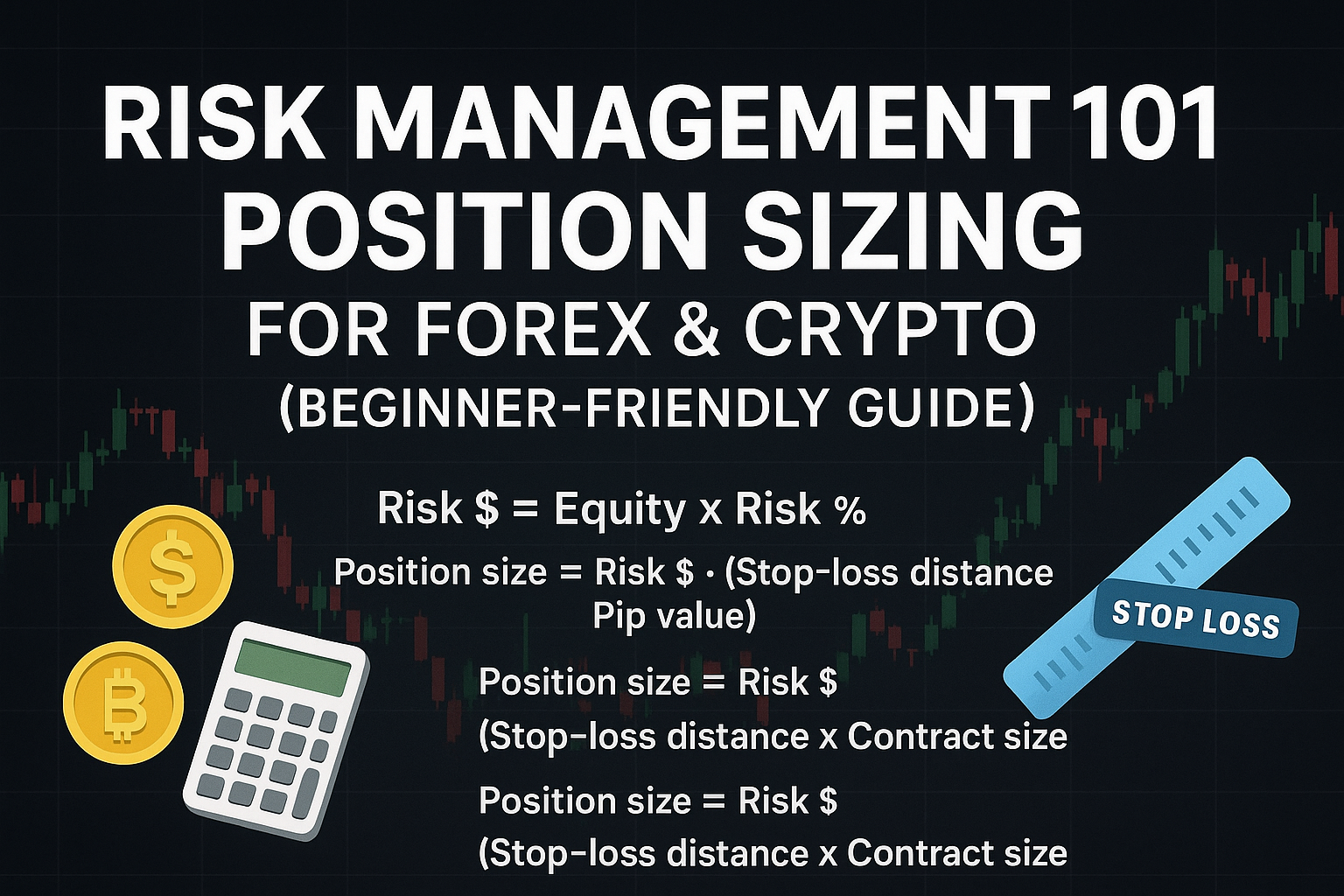
Great entries help, but position sizing decides whether a good idea becomes a sustainable strategy or a roller coaster. In forex and crypto, volatility and leverage magnify both wins and losses. A consistent, rules‑based sizing approach makes your results repeatable and reduces the odds of a blow‑up.
Whether you trade manually or with algorithmic trading/AI trading tools, this article gives you practical methods, examples, and guardrails you can implement today.
Promise: By the end, you’ll know how to pick a per‑trade risk, calculate unit size precisely, cap correlated exposure, and add volatility‑aware adjustments—without guesswork.
Key Concepts (Keep These Handy)
- Account Equity: Your live account value. Recalculate sizing from this number after each closed trade.
- Risk Per Trade (%): The fraction of equity you are willing to lose if the stop is hit (common starting range: 0.25%–1.0%; advanced: up to 2% maximum).
- Stop‑Loss Distance: The price gap between your entry and stop. This converts your percentage risk into actual size.
- R Multiple: Profit or loss measured in units of initial risk.
- Expectancy: Average R per trade across a series. Positive expectancy + consistent sizing = compounding.
- Volatility: Average movement; use ATR or standard deviation to adjust stops and size.
Step 1 — Pick a Risk Budget You Can Actually Follow
Your first decision is risk per trade. Start small to survive the learning curve.
- Beginners: 0.25%–0.5% per trade
- Intermediate: 0.5%–1.0%
- Only after consistent results: up to 1.5%–2.0%
Also define daily/weekly drawdown limits (e.g., stop trading for the day at −3R, for the week at −6R). If you use AI trading or a bot, code these as hard circuit breakers.
Step 2 — Turn Risk Into Position Size (Forex)
The idea is simple: you decide how much you’re willing to lose, then let stop distance and pip value determine the size.
Formula (conceptual):
Position Size (units) = (Account Equity × Risk%) ÷ (Stop Distance in pips × Pip Value per unit
Pip value refresher (majors quoted in USD):
- Standard lot = 100,000 units
- Mini lot = 10,000 units
- Micro lot = 1,000 units
- On EURUSD, $10/pip (standard), $1/pip (mini), $0.10/pip (micro)
Example (EURUSD):
- Equity = $10,000; Risk = 1% ⇒ $100 maximum loss
- Stop = 50 pips; Pip value (mini) ≈ $1/pip
- Needed $/pip to risk $100 = $100 ÷ 50 = $2/pip
- $2/pip ⇒ 0.2 lots (20,000 units)
Spread/Commission: When stops are tight, add the typical spread + expected slippage to the stop distance in your calculation.
Step 3 — Position Size for Crypto (Contracts or Spot)
Crypto sizing depends on whether you trade perpetual futures, spot, or options. We’ll focus on perps and spot.
Perpetual Futures (coin‑margined or USDT‑margined):
- Work from your account risk in USD.
- Determine stop distance as a percentage of entry.
- Compute position notional so that: Risk $ = Notional × (Stop% ÷ Leverage)
Example (BTCUSDT perp):
- Equity = $5,000; Risk = 0.5% ⇒ $25
- Entry = 60,000; Stop = 59,400 (−1.0%)
- Leverage = 5×
- Required notional = $25 ÷ (0.01 ÷ 5) = $25 ÷ 0.002 = $12,500 notional
Spot Crypto:
- Size = Risk $ ÷ Stop% (no leverage). For a 2% stop and $20 risk, you can buy $1,000 worth.
Fees/Funding: Include taker/maker fees and potential funding payments when sizing tight setups.
Step 4 — Choose a Sizing Method (Pick One to Start)
A) Fixed Fractional (Most Popular)
- Risk a fixed % of equity each trade (e.g., 0.5%–1.0%).
- Pros: Scales naturally as your account changes; simple; robust.
- Cons: Can feel slow to grow; still exposes you during high volatility unless stop style adapts.
B) Volatility‑Adjusted Fractional
- Risk a fixed %, but widen stops in volatile regimes and reduce size proportionally.
- How: Use ATR(14) or an ATR‑percentile filter. When ATR is above a threshold, cap size or skip marginal setups.
- Pros: Fewer random stopouts; smoother equity.
- Cons: More parameters to test.
C) Fixed Dollar Risk
- Risk a fixed dollar amount each trade (e.g., $25). Good for micro accounts.
- Pros: Extremely simple.
- Cons: Doesn’t scale with equity; requires manual adjustment as account grows.
D) Kelly‑Fraction Inspired (Advanced)
- Use estimated win rate (W) and payoff ratio (R) to compute an optimal fraction; then take a small fraction of that (e.g., ¼ Kelly) to reduce variance.
- Warning: Estimates are noisy; misuse leads to wild swings. Not for beginners.
AI/Algo Angle: Encode one method, then lock it. Bots shouldn’t “feel braver” after wins or “try to make it back” after losses.
Step 5 — Cap Correlated Exposure (Don’t Stack the Same Bet)
You can be “diversified” and still be long the same theme (e.g., USD strength or crypto beta). Add simple caps:
- Per‑asset cap: Max 1 open position per pair/coin.
- Theme cap (forex): Max 2 USD‑longs or 2 EUR‑shorts at a time.
- Crypto beta cap: No more than X% notional long across BTC + ETH + top alts simultaneously.
- Total open risk cap: Sum of all open risks ≤ 2%–3% of equity.
AI/Algo Angle: Program a risk router that rejects new trades if a cap would be breached.
Step 6 — Daily/Weekly Risk Controls (Circuit Breakers)
- Daily stop: Halt trading at −3R or −2%, whichever comes first.
- Weekly stop: Halt at −6R or −4%.
- Single trade cap: Never risk > 2% (beginners: keep to ≤1%).
- Max consecutive losses: After 3–4 losses, step aside for the session and review.
If you automate, these are hard rules. Humans are too creative under stress.
Sizing Examples You Can Copy
Example 1 — EURUSD Intraday Pullback
- Equity $8,000; Risk 0.75% ⇒ $60
- Entry 1.0850; Stop 1.0830 ⇒ 20 pips
- Pip value (mini) ≈ $1/pip
- Needed $/pip = $60 ÷ 20 = $3/pip
- Size = 0.30 lots (30,000 units)
Example 2 — GBPUSD Swing With ATR Stop
- Equity $12,000; Risk 0.5% ⇒ $60
- ATR(14) on H1 = 18 pips; stop = swing + 1.5× ATR ≈ 27 pips
- $/pip needed = $60 ÷ 27 ≈ $2.22/pip
- Size ≈ 0.22 lots (22,000 units)
Example 3 — BTCUSDT Perp Breakout
- Equity $4,000; Risk 0.5% ⇒ $20
- Entry 58,000; Stop 57,420 (−1.0%)
- Leverage 3×
- Notional = $20 ÷ (0.01 ÷ 3) = $20 ÷ 0.0033… ≈ $6,000
Pro Tip: Round down sizes to account for potential slippage. Always include fees in your expectancy.
Volatility Filters That Save Accounts
Volatility affects both stop distance and position size. Add at least one filter:
- ATR percentile: Trade normal size when ATR is between the 20th–80th percentile of the past 90 days. Reduce size above 80th; skip above 90th.
- Session filter (forex): Favor London/NY overlap; reduce size during Asia unless your system is designed for it.
- News filter: Stand aside or cut risk before high‑impact events (FOMC, CPI, NFP; for crypto: ETF decisions, major protocol upgrades).
AI/Algo Angle: Tag trades with volatility regime labels (low/normal/high) and compare expectancy by regime. Size accordingly.
Trailing, Scaling, and Partial Exits
- Partial exits smooth equity: take 30%–50% at +1R–1.5R, move stop to breakeven, then trail the rest (ATR or structure).
- Scaling in only when initial risk is preserved (e.g., add on pullbacks after moving stop to new swing). Never exceed your total open risk cap.
- Scaling out during spikes locks profit but can reduce outlier capture—test it.
Keep rules explicit so you can backtest or automate them.
Psychology: Sizing You Can Stick With
The “right” size is the one you can execute without flinching. If a normal stopout feels painful, your risk is too high. Fix it before markets fix it for you.
- If you feel tilt after two losses, cut risk in half temporarily.
- If you’re tempted to skip stops, lower your per‑trade risk or widen stops with ATR and recalc size.
- Celebrate process wins: correct size, correct stop, correct exit—even on losing trades.
Backtesting Your Sizing Rules (Simple Workflow)
- Write exact sizing logic (e.g., Risk 0.75%; ATR stop; cap total open risk at 2%).
- Add fees, spread, and slippage.
- Test across multiple pairs/coins and regimes.
- Verify drawdown stays inside your comfort zone.
- Forward test on paper/tiny size and compare live vs. backtest slippage.
AI/Algo Angle: Build a sizing module separate from signal code so you can reuse it across strategies.
Quick Reference: Your Position Sizing Checklist (No Tables)
- Define risk per trade and daily/weekly loss limits.
- Calculate size from stop distance (not from desire).
- Adjust for volatility and fees.
- Cap correlated exposure and total open risk.
- Add circuit breakers for losing streaks.
- Log every trade with size rationale; review weekly.
FAQs
How much should I risk per trade?
Start with 0.25%–0.5%. Move toward 0.5%–1.0% once you prove consistency.
What if my stop is very wide?
Reduce position size proportionally. If size becomes too small to matter, skip the trade.
Is 2% risk per trade okay?
It’s the high end. Many profitable traders prefer ≤1% for smoother equity and lower stress.
Can AI trading handle position sizing automatically?
Yes—encode your sizing rules (risk %, ATR, caps). Bots excel at consistency and instant recalculation.
Should I increase size after a win?
No martingale. Stick to your plan. Adjust size only when equity changes or regime filters trigger.
Summary & Next Steps
Position sizing turns uncertainty into controlled risk. Choose a risk % you can live with, convert stops into size precisely, adjust for volatility, and cap correlated exposure. Whether you trade manually or automate with algorithmic trading/AI trading, consistent sizing is what keeps you in the game long enough for your edge to show.
Keep learning on Indicators101:
- How to Set Stop‑Loss & Take‑Profit in Forex
- Top 10 Common Trading Mistakes Beginners Must Avoid in Forex & Crypto
- Indicators101: Beginner’s Guide to Algorithmic Trading
Call to Action: Ready to systematize risk like a pro? Give our Indicators a try at AITradingSignals.co to standardize entries, exits, and position sizing. Prefer a guided path? Check out our courses at aitradingsignals.gumroad.com for end‑to‑end playbooks, backtesting labs, and risk templates.
Compliance & Disclaimer: This educational material is not investment advice. Trading involves risk, including possible loss of principal. Past performance does not guarantee future results. Ensure any images or charts you publish are original or properly licensed.