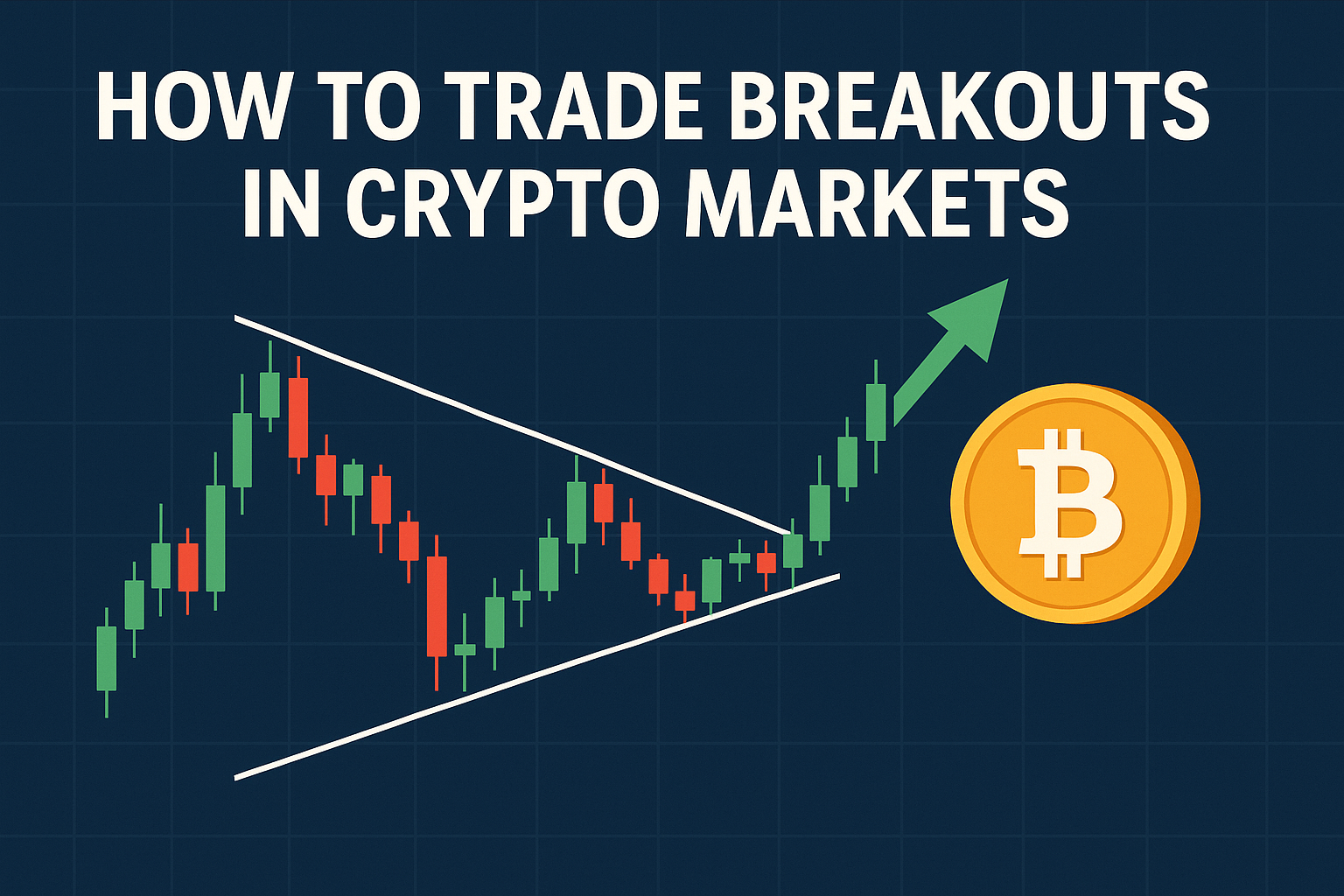
Breakouts try to catch the moment price escapes a consolidation and runs. In crypto, they’re frequent—but noisy—because markets trade 24/7, funding drives positioning, and liquidity varies by hour and venue.
This guide gives you two complete breakout playbooks plus indicator filters, risk rules for perpetual futures and spot, and a realistic backtesting workflow you can automate.
Related reading on Indicators101:
- How to Trade Breakouts in Forex (Techniques + Indicators)
- Risk Management 101: Position Sizing for Forex & Crypto
- How to Build & Backtest a Strategy in TradingView
- Indicators101: Beginner’s Guide to Algorithmic Trading
Promise: By the end, you’ll know how to filter fake‑outs, size positions correctly (including leverage), and code/test your rules—so you catch real expansions without getting chopped.
Core Principles for Crypto Breakouts
- Compression first, then expansion. Look for volatility contraction (tight ranges, BB squeeze, ATR percentile drop) before a break.
- Context beats signals. Watch funding, open interest, and session liquidity (Asia → EU → US). ETF decisions, listings, or major protocol news change behavior.
- Confirmation matters. Demand a close beyond structure or a retest and hold; avoid first‑tick chases.
- Risk before edge. Assume slippage on perps; model fees and funding. Use smaller risk on alts than on BTC/ETH.
Breakout Setups That Work in Crypto
1) Base Breakout + Momentum Confirm (BTC/ETH, H1–H4)
Idea: Trade breakouts from multi‑session bases only when momentum expands.
Rules:
- Define a base range: 10–40 bars with clearly capped highs/lows; ATR below its 20‑bar average.
- Trigger: Candle closes outside the base and momentum confirms (MACD line above zero for longs / below zero for shorts, or ROC(10) > +0.3% / < −0.3%).
- Stop: Opposite side of the base ± a small buffer or 1.5× ATR, whichever is wider.
- Targets: 1–2× base height; keep a runner with a 1.5× ATR trail.
- Guards: Avoid new entries 15 min before major news (ETF rulings, dev updates) and when funding spikes contrary to the trade.
Why it works: Combines structure, compression, and momentum—reducing fake‑outs.
2) Bollinger Squeeze → Expansion (Alts, M30–H1)
Idea: Use BB(20,2) squeeze as a volatility filter; trade expansion with a retest.
Rules:
- Squeeze: BandWidth (upper−lower)/middle below its 6‑month 30th percentile.
- Trigger: Close outside upper band (long) or below lower band (short) with RSI(14) > 50 / < 50>.
- Retest entry (preferred): Next 1–3 candles retest the broken band and hold; enter on a rejection candle close.
- Stop: Inside the band + 0.5× ATR buffer.
- Targets: Fixed R‑multiples (TP1 +1.5R, TP2 +3R) or session ADR.
Why it works: Requires genuine expansion after statistical compression and avoids the initial wick.
3) Daily High/Low Break + VWAP Reclaim (Intraday)
Idea: Trade continuation after a stop run when price reclaims session VWAP.
Rules:
- Mark prior day high/low and current session VWAP.
- On a sweep beyond the level, wait for close back above/below VWAP in the breakout direction.
- Stop: Beyond the reclaim candle; add 0.3–0.7× ATR buffer.
- Targets: Day’s range projection (e.g., ADR bands) or +2R with a trail.
Why it works: Captures trapped traders fueling a second leg.
Indicator Filters (Use Two, Not Ten)
- ATR (14): Prefer breaks when ATR < ATR> before entry; trail with 1.5× ATR once TP1 hits.
- MACD (12/26/9): Confirm momentum on/near the breakout with zero‑line cross.
- RSI (14): Simple bias filter—>50 for longs, <50> for shorts; divergences warn of failure.
- ROC (10): Add a minimal expansion threshold (±0.3%) to avoid slow drifts.
- VWAP: For intraday continuations; reclaim logic reduces fake‑outs.
Keep the stack lean: Structure + ATR + (MACD or RSI) is a solid default.
Risk Management for Perps & Spot
- Per‑trade risk: Start 0.25%–0.75% on alts, 0.5%–1.0% on BTC/ETH.
- Perps sizing: Risk $ = Notional × (Stop% ÷ Leverage) ⇒ Notional = Risk $ × Leverage ÷ Stop%.
- Spot sizing: Position $ = Risk $ ÷ Stop%.
- Stops: Use structure + ATR buffer (0.3–1.5×) and never widen after entry.
- Fees & funding: Assume taker fees on entries (breakouts slip) and funding for expected holding time.
- Exposure caps: Limit total long‑beta risk across BTC/ETH/alts; e.g., max 3% open risk or two correlated alts at once.
- Circuit breakers: Halt after −3R day or −6R week; review before resuming.
Two Copy‑Ready Playbooks
Playbook A — BTCUSDT H1 Base Breakout (MACD + ATR)
- Identify 20+ bar base with ATR(14) < SMA>
- Enter on close above base high and MACD line above zero.
- Stop: Base low − 0.5× ATR (or 1.5× ATR if wider).
- TP1: +1× base height; move stop to breakeven. TP2: +2× base or 1.5× ATR trail.
- Guards: Skip 15 min before major news; avoid if funding is extremely positive (for longs) or negative (for shorts).
Playbook B — SOLUSDT M30 BB Squeeze Retest (RSI + VWAP)
- Confirm BB squeeze (BandWidth in bottom 30% of 6‑month window).
- Break and close above upper band with RSI > 50.
- Retest: Price touches/retests the upper band or VWAP and holds; enter on bullish close.
- Stop: Just inside the band + 0.5× ATR.
- TPs: +1.5R and +3R; trail runner by 1.5× ATR.
Backtesting & Forward Testing (Crypto‑Aware)
- Write exact rules (entries, stops, targets, filters, sessions). No wiggle room.
- Model costs: maker/taker, funding, and realistic slippage—especially for breakouts and small‑cap alts.
- Test across regimes: bull/bear/range, news months (ETFs, upgrades), weekends.
- Use out‑of‑sample windows and small parameter grids; prefer robust plateaus over sharp peaks.
- Forward test for 2–6 weeks on paper or tiny size; compare live expectancy (R/trade) to backtest.
TradingView quick‑start: Code ATR/MACD/RSI filters; place stops with strategy.exit(); add alert conditions if you want semi‑auto execution.
Avoid These Crypto‑Specific Errors
- Chasing listings and social pumps without momentum confirmation.
- Ignoring liquidity on small caps—slippage invalidates your backtest.
- Holding through major news when your plan doesn’t account for it.
- All‑in entries without partials—reduces ability to hold runners.
- Running too many correlated alts—they often move together.
Practical Numbered Examples
Example 1: ETHUSDT H1 Base Break
- Equity $8,000; risk 0.5% ⇒ $40.
- Base height 1.1%; stop set at 1.3% including buffer.
- Leverage 3× → Required notional = $40 × 3 ÷ 0.013 ≈ $9,231.
- TP1 at +1.1%; TP2 at +2.2% or trail 1.5× ATR.
Example 2: SOLUSDT M30 Squeeze Retest
- Equity $5,000; risk 0.4% ⇒ $20.
- Stop 0.9%; spot size = $20 ÷ 0.009 ≈ $2,222 position value.
- TP1 +1.5R (1.35%); TP2 +3R (2.7%); trail remainder.
FAQs
What’s the best timeframe for crypto breakouts?
H1–H4 for clarity on BTC/ETH; M15–H1 for liquid alts. Lower timeframes need stricter cost/slippage modeling.
How do I avoid fake‑outs?
Require compression first, a close outside structure, and momentum confirmation (MACD/ROC/RSI). Retest entries help.
Perps or spot for breakouts?
Perps are fine if you model funding and fees and keep risk small. Spot is simpler for beginners.
Can I automate these rules?
Yes—encode in Pine/MQL/Python. Start with alerts → semi‑auto; add circuit breakers and funding checks.
What about volume?
Use exchange volume for the venue you trade. For multi‑venue assets, treat volume as relative; combine with ATR/momentum filters.
Summary & Next Steps
The highest‑quality crypto breakouts come from compression + confirmation + context with risk sized for slippage and funding. Start with the two playbooks above, code them in TradingView, and run multi‑regime tests. Then forward test on tiny size and let algorithmic trading tools execute the rules consistently.
Call to Action: Ready to systematize your breakout trading? Give our Indicators a try at AITradingSignals.co to spot squeezes and momentum confirms and to manage ATR‑based exits. Prefer a guided path?
Check out our courses at aitradingsignals.gumroad.com for step‑by‑step strategies and Pine labs.
Compliance & Disclaimer: This educational material is not investment advice. Crypto trading involves risk, including possible loss of principal. Past performance does not guarantee future results. Ensure images/charts you publish are original or licensed.