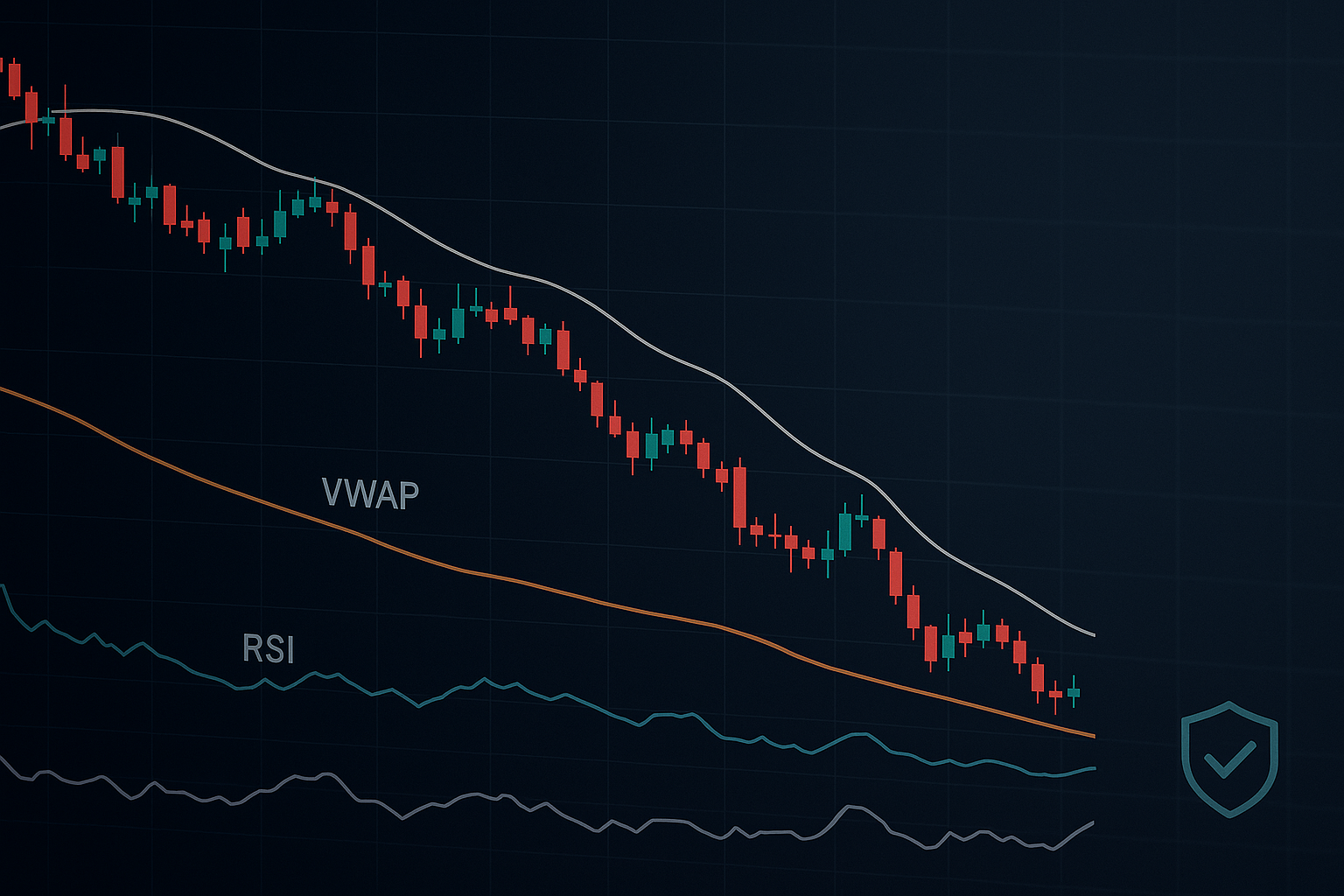
Bear markets are where traders either build discipline or blow up. Prices trend lower, bounces fail, liquidity thins, and news hits harder. The good news: with the right rules, you can preserve capital, grind out returns, and be positioned for the next bull. This guide lays out bear‑market mechanics, survivable playbooks, risk controls, and workflows you can automate with algorithmic trading and AI trading tools.
Related on Indicators101:
- Crypto Market Cycles: Bull, Bear, and Beyond
- Identifying False Breakouts: Tips to Avoid Traps
- How to Trade Breakouts in Crypto Markets
- How to Use Momentum Indicators in Forex Trading (applies to crypto too)
- How to Combine Multiple Indicators (Without Overloading)
Promise: You’ll leave with a step‑by‑step plan to survive (and sometimes thrive) in downtrends—without heroics or hopium.

What Makes a Crypto Bear Market Different
- 24/7 sell pressure: No weekend relief; cascades often start during thin hours.
- Leverage unwinds: Liquidations accelerate down moves; bounces can be sharp but fade.
- Narrative inversion: Good news rallies less; bad news sells more.
- Correlation risk: Alts track BTC/ETH beta; idiosyncratic risk is higher.
- Funding & fees matter: Perp shorts can pay or receive funding; costs compound.
Objective identifiers (stack a few): price below 200‑day; 50‑day < 200>; weekly lower highs/lows; negative funding persisting; breadth weak (few majors above their 50‑day).

Survival Priorities (In Order)
- Capital preservation > profit. Protect ammo for the next cycle.
- Risk consistency. Fixed % risk per trade (smaller than in bull phases) and open‑risk caps.
- System simplicity. One to two playbooks, traded well. No strategy surfing.
- Execution discipline. Pre‑defined checklists, alerts, bots for the boring parts.
- Review cadence. Weekly postmortems; cut what isn’t working.
Position Sizing & Risk (Bear‑Mode Defaults)
- Per‑trade risk: BTC/ETH 0.25%–0.75%; alts 0.10%–0.50%.
- Total open risk cap: ≤ 2–3% across all positions.
- Correlation cap: Max two high‑beta alts at once; prefer BTC/ETH.
- Circuit breakers: Stop trading for the day at −3R or the week at −6R; review before resuming.
- Stop placement: Structure invalidation + ATR buffer (0.5–1.5×) — never widen after entry.
- Scaling rules: Scale out faster; scale in only on clear lowers highs/failed breaks (for shorts) or reclaim signals (for longs).
If you don’t know your R (risk per trade), you’re gambling. Recap our Risk Management 101 if needed.
What to Trade (and What to Skip)
Trade: BTC, ETH, and a few liquid alts. Pairs with deep books and consistent volume.
Skip: Illiquid small caps, new listings, and social pumps—slippage and gaps invalidate backtests.
Venue rules: Match your backtest venue to execution venue; fees/funding differ.

Bear‑Market Playbook #1 — Trend Pullback Short (H1–H4)
Idea: Short with the trend after weak rallies fail. Simple, repeatable.
Tools (lean stack):
- Bias: 50 EMA < 200>; price below 200 EMA (bear bias).
- Setup: Pullback to 20 EMA or prior swing high.
- Trigger: RSI(14) 50‑to‑45 flip (fails to reclaim 50) and a bearish close back under 20 EMA.
- Confirm: MACD line < 0> on/near signal bar.
- Stop: Above pullback swing high + 1× ATR(14).
- Targets: TP1 +1.5R (take 40–50%, move stop to BE); TP2 trail 1.5× ATR or exit at prior daily low.
- Guards: Avoid thin hours; pause 15 min around major news.
Rules (short example):
- H4/H1 bear bias in place.
- Price pulls to 20 EMA; RSI fails at ~50 and rolls over.
- Enter on the close back below 20 EMA with MACD < 0>
- Manage with partials and ATR trail.
Why it works: You sell strength into resistance inside a downtrend and let volatility carry the move.
Bear‑Market Playbook #2 — Failed‑Break Reversal Short (M30–H1)
Idea: Trap chasers on upside breakouts in a bear; fade the failure with tight risk.
Tools:
- Structure: Range or prior high.
- Trigger: Wick above level → close back inside within 1–3 bars → VWAP/AVWAP reclaim down.
- Momentum: RSI < 50> and/or MACD < 0> on the reclaim bar.
- Stop: Above failure wick + 0.5–1.0× ATR buffer.
- Targets: Range mid then opposite side; or +1.5R / +3R with ATR trail.
- Guards: Prefer when funding is positive (crowded longs) and OI just expanded.
Why it works: Bear markets create bull traps; stops fuel the reversal.
Bear‑Market Playbook #3 — Range Fade (Only in Quiet Regimes)
Idea: When volatility compresses and trend pauses, fade clear range edges small and exit fast.
Tools:
- Setup: Well‑defined range; ATR percentile low (e.g., bottom 30% of 6–12 months).
- Trigger: Price hits range edge with RSI divergence; enter on rejection close.
- Stop: Outside range + small buffer.
- Targets: Mid‑range first, then opposite edge; no runners unless trend resumes.
- Guards: Stand aside on news; halt if three losses in a row.
Why it works: In bear pauses, mean reversion returns—but risk small and exit quickly.

Long‑Side Plays (Yes, You Can)
Even in bears, countertrend longs can be taken with strict rules:
A) Reclaim Long (D1/H4)
- Context: Capitulation move, then a daily reclaim of a key level (prior low or AVWAP).
- Filters: RSI > 50 on reclaim bar; volume RVOL > 1.5 if available.
- Stop: Under reclaim candle − 0.5–1.0× ATR.
- Take partials fast; treat as bounces, not trends.
B) Base Breakout (H1) on BTC/ETH only
- Compression: ATR < ATR>
- Trigger: Close above base with MACD > 0 and funding not extreme.
- Stop/targets: Standard breakout rules; tighter trail.
If the long requires hope or a narrative, skip it.
Perps vs. Spot (Risk & Cost)
- Perps (shorting): Pros—two‑sided; Cons—funding, liquidations, slippage. Model funding for expected hold time; prefer taker on entries only if necessary.
- Spot: Simpler, no funding, but you’ll need stablecoin hedges or inverse pairs to express bearish views.
Hedging idea: Size a BTC/ETH short (perps) vs. a basket of spot alts you want to hold long‑term → reduce net beta while keeping exposure to relative outperformance.
Execution Guardrails (Automation Helps)
- No‑trade windows: Disable new trades 10–15 minutes around major releases or exchange maintenance windows.
- Trade caps: Max N trades/day (e.g., 3–5). Cool‑down after 2 consecutive losses.
- Slippage failsafe: If measured slippage > threshold (e.g., 0.15% per market order), reduce size or use limits/retest entries.
- Exposure router: Enforce correlation caps and total open risk ≤ 2–3%.
- Journal bot: Auto‑log screenshots, R, ATR percentile, funding/OI at entry, reason code (pullback short, failed break, etc.).
Indicator Stack (Bear‑Optimized, Minimal)
- Trend filter: 50/200 EMA on H1/H4/D1.
- Momentum: RSI(14) 50‑line behavior (fails at 50 in bears); MACD zero‑line.
- Volatility: ATR(14) + ATR SMA(20) for compression and trailing.
- Flow: RVOL (or tick RVOL), VWAP/AVWAP for reclaims/failures.
- Sentiment (crypto): Funding/OI regime—gate size or entries at extremes.
One indicator per job. If two tools answer the same job, kill one.
Bear‑Market Checklist (Print This)
- Phase: Below 200‑day? Lower highs/lows? Funding negative/volatile?
- Playbook chosen: Pullback short / Failed‑break short / Range fade / Reclaim long.
- Rules met: Trend filter ✓, Trigger ✓, Confirm ✓, ATR stop ✓, News window ✓.
- Risk: Trade risk % = __; Open‑risk after entry = __ (≤ 3%).
- Execution: Market vs limit? Expected slippage? Alert set?
- Plan: TP1 at +1.5R; trail 1.5× ATR; max trades left today: __.
- If wrong: Exit at stop; cool‑down protocol active.

Backtesting & Forward Testing (Bear‑Aware)
- Define rules before seeing results (entries, exits, filters, funding treatment).
- Model costs: Fees, slippage, and funding. Breakouts/failed breaks slip; shorts may pay funding.
- Regimes: Include 12–24 months with prolonged downtrends and violent bear‑market rallies.
- Out‑of‑sample: Tune minimally; roll forward; record.
- Forward test: Paper or tiny size 2–6 weeks; compare live expectancy (R/trade), profit factor (>1.2 target), and max drawdown.
If a tweak boosts in‑sample but dies out‑of‑sample, revert. Simplicity survives.
Psychology: Staying Sane When Everything Bleeds
- Accept boredom. Fewer quality entries = fewer trades. Let them be rare.
- Detach from P&L. Judge yourself by rule adherence and process, not short‑term outcomes.
- Pre‑commit to risk. Write the size before opening the order ticket.
- Protect sleep. Use hard stops and alerts; don’t widen stops at 2am.
- Social diet. Mute doomsday and moonboy feeds. Read charts, not takes.
Practical Numbered Examples (Math Included)
Example 1 — ETHUSDT H1 Trend Pullback Short (Perps 3×)
- Equity $10,000; risk 0.5% ⇒ $50.
- Stop distance (swing + 1× ATR) = 1.2%.
- Notional = $50 × 3 ÷ 0.012 ≈ $12,500.
- Entry on RSI failing 50 and close back under 20 EMA; TP1 +1.5R; ATR trail for runner.
Example 2 — BTCUSDT M30 Failed‑Break Short
- Equity $8,000; risk 0.4% ⇒ $32.
- Failure wick stop buffer = 0.9%.
- Notional = $32 × 3 ÷ 0.009 ≈ $10,667.
- Targets: Mid‑range then opposite edge; tighten trail near prior daily low.
Example 3 — Spot Reclaim Long (Countertrend, Small Size)
- Equity $6,000; risk 0.25% ⇒ $15.
- Stop under reclaim candle = 1.0% → Position = $15 ÷ 0.01 = $1,500 spot.
- Partial at +1.5R; exit remainder at next resistance or ATR trail.

FAQs
Should I stop trading entirely during a bear?
If you don’t have tested short or range strategies and can’t follow strict risk rules, yes—sit in cash or only DCA your long‑term spot plan.
Is DCA still valid?
Yes—for investment horizons. For trading, keep DCA separate from your short‑term systems to avoid bias.
What about hedging?
Hedging BTC/ETH perps against spot reduces beta but adds funding and complexity. Use clear size formulas and review funding.
Which timeframes work best?
H1/H4 for clarity; M15–M30 for failed‑break setups around session moves; D1 for reclaim signals.
How do I know when the bear ends?
You won’t catch the exact bottom. Watch for weekly trend shifts (higher highs/lows), price > 200‑day, expanding breadth, and sustained spot/ETF inflows.
Summary & Next Steps
In a crypto bear market, defense wins first. Trade fewer, higher‑quality setups: pullback shorts, failed‑break reversals, occasional reclaim longs—all with small, fixed risk and ATR‑based management. Automate guardrails (no‑trade windows, trade caps, exposure router), journal relentlessly, and keep your playbook simple. When the cycle turns, you’ll still be in the game—and sharper.
Call to Action: Want plug‑and‑play tools for these bear‑market playbooks? Give our Indicators a try at AITradingSignals.co for trend filters, failed‑break detection, and ATR‑based risk. Prefer a guided path?
Check out our courses at aitradingsignals.gumroad.com for step‑by‑step systems and backtesting labs.
Compliance & Disclaimer: This educational material is not investment advice. Crypto trading involves risk, including possible loss of principal. Past performance does not guarantee future results. Use only original or licensed images/charts.